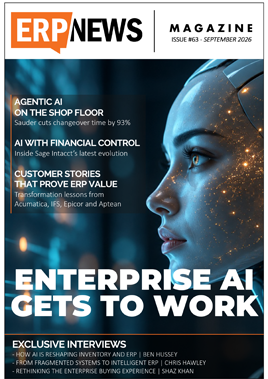
As artificial intelligence becomes more embedded in enterprise systems, finance is emerging as one of the first functions to experience a fundamental shift in how work gets done. The conversation is moving beyond automation and efficiency gains toward a more advanced model—where AI not only supports decisions but actively progresses tasks within financial workflows.
This evolution introduces new questions around trust, governance, and accountability, particularly in environments where accuracy and compliance are critical. At the same time, it is reshaping the role of finance teams, shifting focus from transaction processing to oversight, exception management, and strategic decision-making.
In this ERP News Q&A, Dan Miller, EVP of Financials & ERP Division at Sage, discusses how agentic AI is transforming finance operations, what differentiates true workflow execution from traditional automation, and how organizations can balance innovation with control as AI becomes a core part of enterprise decision-making.

From Decision Support to Workflow Execution
Q: Sage is positioning AI agents as moving beyond analysis into executing tasks within workflows. What changes inside finance teams when AI shifts from “supporting decisions” to actively progressing work?
A: The biggest change is how finance teams spend their time – moving away from manual execution and toward exception-based review and oversight. In addition, AI can help move work forward. For example – AI agents can prepare actions such as payment reminders or approvals inside software like Sage Intacct, while people remain responsible for reviewing and authorizing outcomes. For finance teams, that creates room to focus less on repetitive processing and more on judgment, oversight, and action.
Q: Trust and accountability have been central themes across Sage’s recent announcements. In practical terms, how can CFOs confidently stand behind decisions that are partially driven by AI?
A: CFOs can stand behind AI-supported decisions only if the system is designed with built-in governance and trust. Sage is committed to building AI you can trust, which comes down to three things: confidence, control, and accountability. Users should be able to understand how an output or recommendation was produced, humans should approve actions, and every AI-provided output should be traceable and auditable.
CFOs remain accountable for the accuracy of the information they provide, so they need transparency into what the AI did, what prompted it, how it arrived at an outcome, and who approved the final action. Privacy and security expectations also cannot change just because AI is involved. In a high-stakes environment like finance, trust has to be built into the way AI works from the start.
The Real Barriers to AI Adoption
Q: Despite rapid innovation, many finance teams still struggle with fragmented systems and data silos. Based on what you’re seeing with customers, what is the biggest blocker to meaningful AI adoption today?
A: AI has the potential to help solve the data fragmentation problem. Fragmentation itself is not really a blocker as AI has the capability of working across systems to bring things together. Sage is doing this with our Developer Program.
The biggest blocker to adoption is the fear that you have to do it all at the same time. In conversations with thought-leading CFOs, choosing where to test AI and having a rigorous program for evaluation is helping companies adopt advanced technology and deliver time saving value. The real trick is to not be overwhelmed by all the noise and industry hype and rather be focused on business outcomes and willing to try new things to drive those outcomes.
Q: There is growing momentum around agentic AI across the industry. Where do you see the real difference between incremental automation and truly agent-driven workflows in finance?
A: Incremental automation improves efficiency, but it doesn’t fundamentally change how work flows through finance processes – agent-driven workflows do.
Traditional automation speeds up individual steps but still relies on humans to push work forward. Agentic AI can proactively identify issues, prepare recommended actions, and progress work within defined guardrails. At Sage, these agents are domain-specific and deeply embedded into finance workflows, operating with supervised autonomy. The system knows when to assist, when to prepare actions, and when to require human approval. The value of agentic AI is not simply that it can act, but that it can help move work forward in a governed, explainable, and controlled way.
Governance, Control, and Auditability
Q: As more processes become automated, how do organizations maintain control, auditability, and governance—especially in highly regulated environments?
A: To maintain control, AI should operate with the same governance and accountability as humans. Consequential actions should require explicit human approval; agents should operate within clearly defined guardrails and permissions; and every action should be auditable.
This is how Sage AI capabilities operate – within customer-defined permissions, approval thresholds, and audit requirements; high-impact actions require explicit human authorization; and every AI-supported step is recorded. This ensures nothing happens without accountability or visibility. AI assists and prepares work, but decision making requires human intervention. The system maintains a full audit trail covering recommendations, approvals, and execution, supporting compliance and regulatory review.
Q: Many of the latest developments point to a shift in how finance operates. How do you see the role of finance teams evolving over the next 2–3 years as AI becomes more embedded in day-to-day workflows?
A: Over the next few years, finance teams are likely to spend less time processing transactions and more time reviewing exceptions, applying judgment, and helping guide the business. As AI becomes more embedded in day-to-day workflows, the role of finance will shift from manual execution toward oversight, decision-making, and driving the business.
That change will make finance roles more strategic. CFOs and operations leaders will have a broader set of responsibilities including business strategy, investment decisions, and predictive analytics. Teams will be expected to move faster while maintaining strong judgment, governance, and clarity. As more routine work is automated, finance leaders will play a bigger role in validating outcomes, managing risk, and helping shape business decisions with greater confidence.
Building Connected Enterprise Workflows
Q: Sage is bringing together finance, HR, and operational workflows into a more connected platform. How do you ensure this increased integration reduces complexity rather than introducing new layers to manage?
A: The purpose of integration is to remove friction, not create additional layers. Sage’s approach focuses on connecting workflows natively, so data moves automatically between finance, HR, payroll, and operations, through solutions like Sage HCM. This reduces duplicate entry, eliminates unnecessary reconciliations, and gives teams a single source of truth. Sage HCM links HR, payroll, and workforce data directly into finance workflows so organizations have a clearer view of labor costs and less duplicate entry between systems.
This type of integration reduces complexity when it improves visibility, removes manual handoffs, and helps customers operate from shared, trusted data rather than creating another layer on top.
Q: With the expansion of the developer platform and AI tooling, partners are playing a growing role in innovation. How do you balance openness with maintaining consistency, trust, and quality across the ecosystem?
A: The right balance is openness within a governed platform model. Sage is opening its platform through tools like Agent Builder and the AI Gateway, but all partner-built solutions operate within Sage’s framework centered around trust, control, and accountability. This enforces consistent standards for security, interoperability, explainability, and auditability.
That balance allows partners to innovate and bring specialized expertise into customer workflows, while ensuring customers experience the same level of confidence and control whether a capability is built by Sage or by a partner. Strong governance at the core makes it possible for partner-built agents to integrate into workflows while still meeting the standards customers expect in finance and operations.
Why Industry Context Still Matters
Q: Sage continues to invest in industry-specific capabilities across its portfolio. How important is vertical specialization in delivering real value from AI, compared to more general-purpose solutions?
A: Industry specialization is very important because workflow varies by industry. Sage embeds deep domain expertise directly into its AI models and workflows, so recommendations reflect industry-specific operational and compliance requirements. General-purpose AI can be powerful, but real value comes from embedding AI into the actual workflows, rules, and contexts in which customers operate.
Q: As AI becomes more embedded across finance and operations, how should organizations measure success? What metrics actually indicate that these technologies are delivering meaningful business value?
A: Success isn’t measured by how often AI is used, but by the outcomes it enables. The most meaningful metrics are the ones that show whether teams are saving time, reducing errors, improving visibility, and operating with stronger confidence – things like routine finance tasks taking minutes not days, fewer errors, better visibility, and stronger confidence because every action is traceable and governed. When finance teams can move faster with more clarity and control, AI is delivering real value.

ERP News Editorial Team
The ERPNews Editorial Team covers global developments in ERP (Enterprise Resource Planning), enterprise software, cloud platforms, AI, automation, and digital transformation, providing independent news and editorial analysis for senior business and technology leaders. Our reporting focuses on market signals, strategic shifts, and enterprise impact across the ERP and enterprise technology ecosystem.
For editorial inquiries, please contact:
📩 [email protected]