
Syspro has launched Torque, a new industrial AI platform designed to move artificial intelligence beyond analysis and recommendations and into controlled operational action across manufacturing environments.
Announced on September 2, Syspro Torque connects with ERP and shop-floor systems to identify operational issues, recommend responses and, where authorized, execute actions. The platform is designed to work with existing technology environments rather than requiring manufacturers to replace their core systems, supporting ERP platforms alongside manufacturing execution systems (MES), SCADA, warehouse technologies and other operational data sources.
The launch reflects a broader shift taking place across enterprise software. As manufacturers explore agentic AI, the challenge is increasingly not whether AI can generate an answer, but whether it can act safely within complex production environments where a single decision may affect inventory, suppliers, capacity, scheduling, quality, costing and customer commitments.
For Syspro, the answer lies in combining AI-driven action with traceability and operator control.
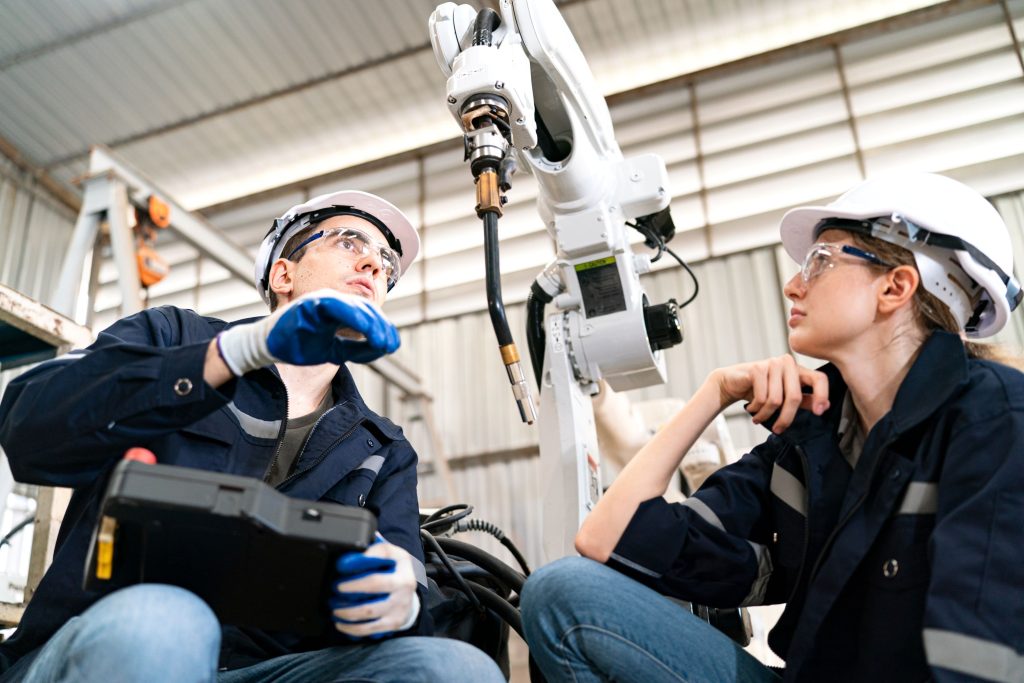
From ERP Insight to Operational Action
ERP systems have traditionally provided manufacturers with a structured record of transactions and operations. The emerging opportunity for industrial AI is to use that information — alongside production and shop-floor data — to determine what needs attention and initiate the appropriate response.
Torque is built around that model.
According to Syspro, the platform uses a manufacturing knowledge graph informed by nearly five decades of industry experience. It combines this context with information such as orders, inventory, production schedules, supplier data and shop-floor activity.
The platform is ERP-agnostic, although Syspro says it can draw on deeper manufacturing context when deployed alongside Syspro ERP.
Rather than positioning AI as another standalone application, Torque effectively introduces an intelligence and action layer across the existing manufacturing technology stack.
“Manufacturers won’t hand decisions to a black box, and they shouldn’t,” said Chris Lloyd, Chief Solutions & Technology Officer at Syspro. “Torque connects to the ERP and the systems already on the floor, so its decisions reflect the whole operation. And most critically, Torque shows its work behind every action.”
Building Manufacturing AI Agents Without Coding
One of the more significant elements of Torque is the way Syspro is approaching agent creation.
Operations teams can describe in plain language what they want an AI agent to do, with Torque then building the workflow without requiring manual coding. The intention is to put more control over AI automation into the hands of the people who understand manufacturing processes and business rules rather than making every new use case dependent on a development team.
This could prove important as manufacturers move from isolated AI pilots toward larger portfolios of operational agents.
Potential users extend across planning, production, warehousing, compliance and customer service, while executives can monitor how individual workflows affect operational performance.
The approach also raises an important question for the wider ERP market: as natural-language agent creation matures, will the next generation of enterprise automation be configured primarily by IT teams, or increasingly by operational specialists working within governance frameworks established by IT?
Connecting AI Across ERP, MES and the Shop Floor
Industrial environments rarely operate on a single technology platform. ERP may coexist with MES, warehouse systems, production equipment and older SCADA infrastructure, often spanning both cloud and on-premises environments.
Torque is designed for this heterogeneous reality.
Syspro says the platform uses Model Context Protocol (MCP) connectors to interact with ERP systems, legacy SCADA environments, MES platforms, warehouse hardware and other data sources without requiring bespoke middleware for every connection.
That interoperability is central to the proposition. An AI agent making a production or supply chain decision may need context from several systems before it can understand the consequences of an action.
For manufacturers, therefore, the emerging agentic AI discussion is closely tied to a longstanding integration problem: AI can only make useful operational decisions if it has access to sufficiently connected, contextualized and reliable information.
Syspro Puts Auditability at the Center of Agentic AI
Perhaps the most consequential aspect of the launch is Syspro’s emphasis on explainability.
Torque operates according to what the company calls its “Glass House” principle: recommendations and actions should expose the reasoning behind them rather than operating as an opaque AI process.
For each action, Torque records the business rules applied, the data sources used and the tools involved. Operators can inspect the reasoning and, where necessary, correct the underlying information.
Manufacturers can also determine how much authority individual workflows receive. One process could require human approval before every action, while a mature and predictable workflow could be permitted to execute autonomously.
That graduated model of autonomy could become increasingly important as AI agents enter ERP environments.
The question for manufacturers is unlikely to be simply whether to allow autonomous AI. Instead, organizations will need to decide which decisions can be delegated, under what conditions, with what evidence, and with which controls for intervention and audit.
Leanne Taylor, CEO at Syspro, positioned the platform within that transition.
“Manufacturers have always relied on ERP to run their business, but knowing what happened yesterday is not the same as knowing what to do today or knowing how to do it better,” she said. “Every action is governed, visible and auditable. Change gets faster and smarter, not slower and riskier.”
Governance Could Become a Competitive Issue for Industrial AI
The emphasis on auditability also reflects the particular constraints of manufacturing.
A generative AI error in a general productivity application and an incorrect automated action affecting production, purchasing or inventory carry very different operational consequences.
That makes governance an architectural requirement rather than an additional enterprise feature.
Syspro says Torque minimizes unnecessary movement of customer data. Only information required for a specific workflow is sent to AI models in transit, where it is encrypted, while its AI providers do not retain that information. The company also says customer data is not used to train shared models.
The broader significance is that enterprise AI platforms are beginning to compete not only on intelligence, but on the mechanisms surrounding that intelligence: permissions, explainability, data handling, human oversight and audit trails.
For ERP buyers evaluating agentic AI, those controls may become as important as the underlying model capabilities.
Moving From AI Experimentation to Measurable Workflows
Syspro is also taking a workflow-level approach to AI economics.
Before a Torque workflow runs, manufacturers can see an estimated cost, determine its execution cadence and monitor what the agent delivers. Pricing is usage-based, allowing organizations to begin with an individual workflow and expand deployment as additional use cases demonstrate value.
That model addresses an emerging challenge as enterprise AI adoption expands: understanding whether increased model consumption is producing measurable operational improvements.
Rather than encouraging AI use for its own sake, Syspro is positioning Torque around repeatable workflows where organizations can evaluate the relationship between AI consumption and operational outcomes.
This focus aligns with comments included in the announcement from Charles Brennan, Senior Analyst at Nucleus Research, who pointed to practical applications and measurable operational improvements as the areas where embedded AI within ERP is likely to deliver the greatest value.
Controlled Availability Begins Across Manufacturing and Distribution
Torque entered controlled availability in August 2026, with participating manufacturers and distributors spanning food and beverage, fabricated metals and industrial equipment.
The group ranges from mid-market manufacturers to distributors with more than $2 billion in revenue, according to Syspro.
Participants are working with the company to determine which decisions the platform should recommend, which actions it can execute and how the results should be measured. Partners are also participating in the program as Syspro develops implementation approaches ahead of wider availability.
Torque is scheduled to make its first public showcase at IMTS 2026 in Chicago, running September 14–19.
Agentic AI Pushes ERP Toward a New Role
Torque arrives as the ERP industry begins confronting a more fundamental change in the role of enterprise systems.
The first wave of enterprise generative AI largely focused on helping users retrieve information, summarize data and interact with software through natural language. Agentic systems introduce a different proposition: software that can interpret operational conditions and participate directly in executing business processes.
For manufacturing, that transition is particularly significant.
ERP contains critical context around orders, materials, inventory, suppliers, costs and customer commitments, but many operational decisions extend beyond ERP into production and shop-floor systems. Connecting those environments while maintaining governance could therefore become one of the defining challenges for industrial AI.
Syspro’s approach with Torque suggests that the next stage of ERP intelligence may not be about replacing existing systems with an AI-native architecture. Instead, it could involve creating an auditable agentic layer capable of understanding those systems collectively and acting across them.
The competitive question will ultimately be less about how many AI features an ERP vendor can introduce and more about whether manufacturers can trust those systems to make — and eventually execute — consequential operational decisions.
In that environment, explainability, integration and controlled autonomy may become as important as intelligence itself.

ERP News Editorial Team
The ERPNews Editorial Team covers global developments in ERP (Enterprise Resource Planning), enterprise software, cloud platforms, AI, automation, and digital transformation, providing independent news and editorial analysis for senior business and technology leaders. Our reporting focuses on market signals, strategic shifts, and enterprise impact across the ERP and enterprise technology ecosystem.
For editorial inquiries, please contact:
📩 [email protected]