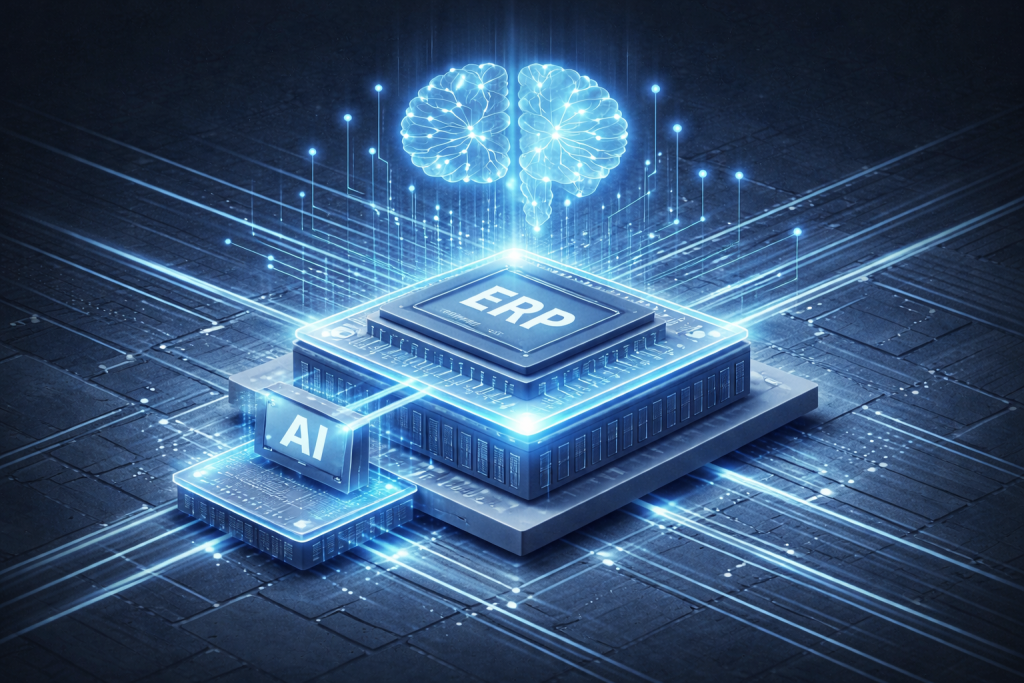
The history of Enterprise Resource Planning (ERP) transformation is marked by its complexity and inherent challenges. The dominant approach to modernization involves a costly, disruptive and time-consuming process known as “rip and replace,” where organizations would completely dismantle their existing legacy systems and install a new core platform.
This massive undertaking required years of planning, extensive data migration and significant overhauls of established business processes, often leading to project delays, budget overruns and substantial organizational resistance due to the drastic scale of change. Replacing an existing ERP platform to take advantage of newer technologies and capabilities can be viewed as a high-stakes endeavor with an uncertain return on investment.
With the advent of AI and its growing capabilities, ERP augmentation will be the more strategic path for digital transformation in 2026.
AI-based ERP augmentation bypasses the need for a full rip-and-replace, focusing instead on surgical, high-impact improvements without shutting down the stable core of the business. It involves layering advanced AI-powered modules – like predictive analytics, intelligent automation and conversational AI – to work with your existing ERP’s data and processes.
When done correctly, AI systems that augment new or legacy ERPs, can revitalize ERP assets to effectively address workflow process gaps. Additionally, the AI system can ensure that new data can be connected to legacy data, documentation is maintained, and all of it follows business and security rules. The power of quickly addressing ERP workflow process gaps rests in delivering a single, flexible interface, with the added ability to store data in such a way that an AI system can combine it with ERP data to create seamless reporting of cost, expense, time and thus productivity. The cost of, and speed of, adding that flexible interface to the ERP is much easier to rationalize compared to individual customizations within the ERP for individual corner cases.
AI systems can be configured and updated to augment legacy ERP implementations that will make it easier for end users to operate, while integrating new data sets with a central data store for reporting – while keeping faithful to all business rules, security rules and the business governance policies of the underlying enterprise software systems. All of this happens while the business is still working, collecting new and old data and providing new levels of actionable intelligence as AI-powered modules are added.
AI-augmentation of an ERP can allow workflows to be more flexible than with legacy or recently purchased ERP platforms because all workflows must be carefully tested and planned ahead of time. The AI networks become the user interface and are flexible enough to be quickly reconfigured as needed. AI systems can allow workflows to proceed based on logical business rules which can be easily updated.
Workflow process gaps continue to grow exponentially. If left unchecked, they will hinder the accurate tracking, analysis, reporting and operations of business activities. By adding modular augmentations, new workflow process gaps can be more readily addressed because the whole ERP platform does not need to be modified.
Leveraging AI systems as the user interface allows better data collection and management while rapidly adapting and adding new workflows which are promptly tailored to address new corner cases. By leveraging an AI augmentation transformation of their ERP platforms, businesses and organizations can increase operational efficiency, tracking and reporting, while maintaining security – and functional uptime.
Ultimately, AI-based ERP augmentation is the best transformation strategy because it establishes a foundation for continuous innovation. It provides a flexible, modular architecture where new AI capabilities can be plugged in as they become available, ensuring the ERP system – and the business – becomes more nimble, competitive and intelligent.
By maximizing the value of existing technology, minimizing disruption, and delivering strategic, measurable benefits almost immediately, augmentation represents the evolution of ERP. By establishing a modular ERP augmented architecture, businesses can benefit from new AI capabilities as they mature, ensuring continuous innovation. It’s a shift from being a system of record to a system of intelligence that actively shapes the future of the enterprise.

Ken Fischer
Ken Fischer is the CEO of Atigro, the proven ERP transformation firm that pairs its modular augmentation capabilities with AI-native frameworks. Atigro’s experience and capabilities generate the rapid development and provisioning of new ERP functionality that meets dynamically changing business processes.