
Executive Summary
For countless manufacturers, legacy ERP systems like QAD Standard Edition or SAP R/3 remain the digital backbone of their operations. Yet, despite their stability, the procure-to-pay (P2P) processes running on them are often riddled with manual work. Inadequate data quality alone costs businesses an average of $12.9 million annually (IBM, 2016), a figure inflated by the countless hours finance and supply chain teams spend on manual data entry. Manufacturers relying on legacy ERPs often spend hundreds of hours on redundant tasks that modern automation can eliminate. The issue extends beyond mere time squandered. More than 40% of employees dedicate at least 25% of their workweek to manual, repetitive tasks, with data input occupying most of their productive time (Smartsheet, 2019). The manufacturing sector faces unique challenges with legacy systems—like QAD Standard Edition or SAP R/3—that were designed for stability and transactional integrity, not user efficiency or seamless integration. Despite high upgrade costs and risks, many manufacturers continue using these outdated platforms, resulting in a productivity gap as employees trained on modern applications find it difficult to manage complex business processes. This is where ETLs come in. They enable the structured, controlled movement of suppliers, purchase order, receipt, invoice, and payment data between disparate systems. When combined with staging tables, validation logic, and reconciliation controls, ETLs allow organizations to achieve scalable automation while preserving ERP integrity (Kimball & Caserta, 2011; Golfarelli & Rizzi, 2018). Gartner research highlights that data integration technologies remain central to modernizing enterprise systems where API capabilities are limited (Gartner, 2022). Industry benchmarking indicates that automated invoice validation can reduce processing costs by over 50 percent compared with manual invoice entry workflows (Ardent Partners, 2021).

Why does ETL-led automation work in legacy ERP?
Legacy ERPs were built before APIs became standard. ETLs provide a reliable alternative by enabling scheduled, governed data integration. Unlike manual processes, they enforce consistent validation, reduce errors, and provide audit-ready traceability. This allows finance teams to increase invoice throughput while maintaining compliance without being locked into a costly upgrade cycle.
Implementation Challenges to Consider
However, ETL is not a silver bullet, experts caution that an ungoverned proliferation of point-to-point ETLs can create a complex, hard-to-maintain “spaghetti” architecture. Furthermore, batch-oriented ETL processes introduce latency, which may not suit manufacturers requiring real-time visibility into cash flow or commitments.
Case in Point: An Automotive Manufacturer’s Productivity Leap
A leading automotive manufacturer faced these exact challenges with its QAD ERP version SE 2013. The inflexible system demanded extensive manual data entry for every transaction. Finance teams spent hours inputting supplier bills, while supply chain managers individually processed hundreds of purchase orders weekly. The planning team manually updated thousands of item parameters each month.
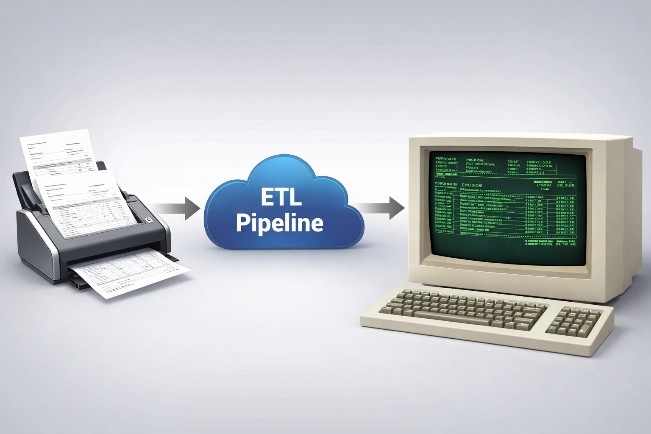
The solution was ETL-driven automation, which bypassed the slow, screen-by-screen front-end interface entirely.
- A Requisition and PO Import Utility allowed bulk generation of orders that previously required individual entry.
- A Supplier Invoice Import Utility extracted Excel-based invoice data for systematic, automatic input.
- An Item and Schedule Order Update Utility automated the mass updates to planning parameters.
The financial impact was significant. By automating these bulk operations, the company saved over 150 man hours per week. At a conservative rate of $60 per hour for manual processing, this resulted in weekly savings of over $9,000 and annual savings of approximately $500,000.

Typical KPI Improvements
Across the board, these automation efforts drove dramatic improvements in core metrics. The invoice cycle time decreased from 16 days to 6 days. Touchless processing rose from 22% to 70%. Exception rates decreased by 41%, while accounts payable processing expenses diminished by 35%.
| KPI | Before ETL | After ETL |
| Invoice cycle time | 14–20 days | 4–7 days |
| Touchless rate | 15–30% | 60–75% |
| Exception rate | 35–50% | 15–25% |
| Cost per invoice | $10–$15 | $6–$9 |
Key Automation Targets in the P2P Cycle
- Supplier Master Data: Standardize onboarding by using ETL pipelines to validate mandatory fields and approvals before loading data into the ERP. This single step dramatically reduces downstream invoice failures.
- Invoice Intake and Validation: ETLs take structured data from invoice capture platforms and validate it against existing POs and receipts. Invalid invoices are rejected early, slashing manual correction effort.
Governance and Control Framework
For finance leaders, control is paramount. Well-designed ETL pipelines generate detailed audit trails, reconciliation logs, and approval records. These controls ensure compliance with financial reporting requirements, maintain data integrity, and provide auditors with a clear, reviewable trail.
Implementation Roadmap
Organizations should adopt a phased approach to minimizing disruption:
- Phase 1: Invoice Automation. Start here for the quickest ROI on time and cost savings.
- Phase 2: Supplier Master Synchronization. Clean and automate the data at the source.
- Phase 3: Payment Visibility Integration. Extend automation to outbound transactions for a truly touchless process.
Conclusion: A Pragmatic Path to Modernization
The mandate for manufacturers is clear: optimize or be left behind. ETL-led automation offers a high-ROI path to modernizing the procure-to-pay function without the risk and expense of a core ERP replacement. By adopting a phased approach and focusing on governance, companies can unlock significant efficiency gains, improve data accuracy, and empower their teams to focus on strategic work turning their legacy system from a bottleneck into a backbone for growth.
References
Ardent Partners. (2021). Accounts Payable Automation Benchmark Report.
IBM. (2016). The Cost of Poor Data Quality. IBM Analytics Report.
Smartsheet. (2019). Automation in the Workplace Report.
Kimball, R., & Caserta, J. (2011). The Data Warehouse ETL Toolkit: Practical Techniques for Extracting, Cleaning, Conforming, and Delivering Data. Wiley.
Golfarelli, M., & Rizzi, S. (2018). Data Warehouse Design: Modern Principles and Methodologies. McGraw-Hill.
Gartner. (2022). Market Guide for Data Integration Tools.