
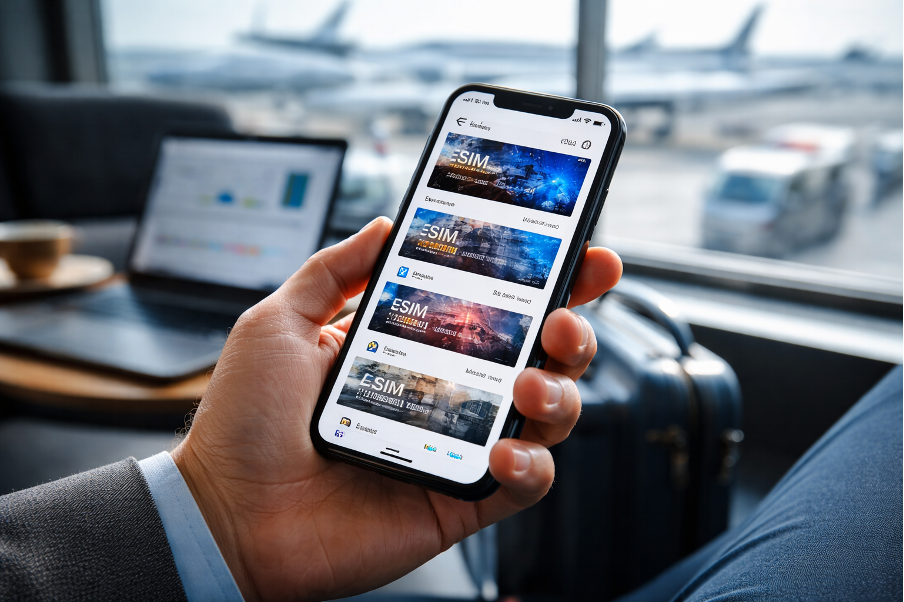
Professional mobility has become an integral part of how modern organizations operate. Consultants, executives, sales teams, and technical specialists increasingly work while traveling and must remain connected to digital tools at all times. In this context, eSIM technology is emerging as a major evolution in mobile connectivity.
Unlike physical SIM cards, an eSIM is built directly into compatible devices and can be activated entirely digitally. This approach is changing how professionals access mobile data, particularly when traveling internationally.
What is an eSIM and why does it matter?
An eSIM (embedded SIM) is a digital SIM integrated into smartphones, tablets, and laptops that support the technology. It allows users to download and activate a mobile data profile remotely, without inserting or swapping a physical card.
For professional users, this technology offers several clear advantages:
- fast activation without physical SIM handling
- remote management of connectivity profiles
- no need for retail visits or local operators
- uninterrupted service during international travel
eSIM technology responds to a growing demand for simplicity, flexibility, and efficiency in mobile connectivity.
Addressing the challenges of international mobility
International business travel often comes with connectivity challenges. Traditional solutions rely on roaming agreements, physical SIM cards, or public Wi-Fi networks, all of which can introduce friction, delays, or unexpected costs.
eSIM technology removes many of these obstacles by enabling professionals to connect as soon as they arrive at their destination, without configuration issues or service interruptions. For frequent travelers, this represents a significant improvement in reliability and user experience.
A digital-first approach aligned with enterprise transformation
As businesses increasingly adopt cloud platforms and mobile-accessible tools, continuous connectivity is essential. eSIM technology aligns naturally with this digital transformation by replacing physical components with software-based solutions.
This shift reflects a broader trend across IT environments: reducing hardware dependency, simplifying provisioning, and enabling more agile operating models.
Simplified management and user autonomy
With eSIMs, managing mobile connectivity becomes more autonomous. Users can activate, update, or renew their data plans directly on their devices, without external assistance.
Within this ecosystem, providers such as Holafly offer app-based eSIM solutions that allow users to control their connectivity directly from their smartphones. For professionals evaluating digital connectivity options, the ability to download the Holafly app provides a simple way to activate and manage mobile data without dealing with physical SIM cards or operator visits.
Reliability and security benefits
eSIM technology also contributes to more reliable and secure mobile connections. By reducing reliance on public Wi-Fi networks and providing direct mobile data access, eSIMs help limit exposure to unsecured networks.
For professionals accessing sensitive tools or data while traveling, this reliability supports safer and more consistent connectivity.
Toward broader adoption of eSIMs
As device compatibility continues to expand and mobile work becomes more common, eSIM technology is steadily moving toward mainstream adoption. Professionals seeking flexible, digital-first connectivity are increasingly turning to eSIMs as a practical alternative to traditional SIM cards.
In a working world where mobility is the norm rather than the exception, eSIM technology is positioning itself as a core enabler of seamless, borderless connectivity—without the constraints of physical hardware.