The Illusion of Intelligent Procurement
Enterprise procurement is often bottlenecked not by a lack of inventory, but by the rigidity of the search experience. Employees know exactly what they need to accomplish their tasks, but they rarely know the specific part numbers, brand restrictions, or standard corporate nomenclature.
When organizations attempt to modernize legacy ERP portals by simply bolting on Generative AI (GenAI) chatbots, they quickly fall into the “AI Trap.” Large Language Models (LLMs) are brilliant at conversational UX and semantic understanding, but they are prone to hallucinations. They are designed to predict text, not to calculate real-time warehouse balances or enforce strict multi-org security rules.
Imagine an engineering manager requesting a “15-inch mobile workstation with maximum RAM for heavy CAD rendering.” A naive AI search might prioritize a standard 16GB office laptop simply because the word “Standard” aligns closer to the “Enterprise” context in its multi-dimensional space, completely ignoring the strict hardware requirement. The result? Frustrated users, incorrect hardware deployments, and a procurement cycle that requires manual intervention.

The Solution: A Hybrid AI Engine
To build a truly intelligent procurement catalog, the system must bridge the gap between GenAI’s natural language fluency and strict database logic. The solution is an Enterprise RAG (Retrieval-Augmented Generation) architecture. It pairs the cognitive intent-parsing of GenAI with the strict determinism of Hybrid Vector Search.
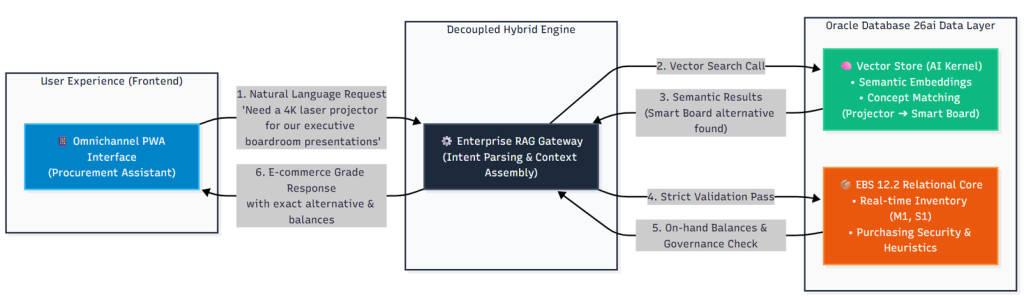
To demonstrate this in practice, an intelligent Progressive Web App (PWA) layer was engineered over Oracle E-Business Suite (EBS), utilizing the native AI Vector Search capabilities of the Oracle 26ai database.
This architecture introduces four high-impact workflows:
1. Proactive Semantic Discovery: Breaking Down Brand Silos
In a traditional ERP portal, searching for a specific brand often yields a blank page if the item is out of stock or not supplied. Users are forced to guess alternative keywords.
This hybrid engine changes the paradigm by understanding the functional intent behind a query. If a user searches for an “Apple Magic Keyboard,” the system doesn’t just look for the word “Apple.” The vector model recognizes the underlying semantic cluster: a premium, wireless, macOS-compatible keyboard.
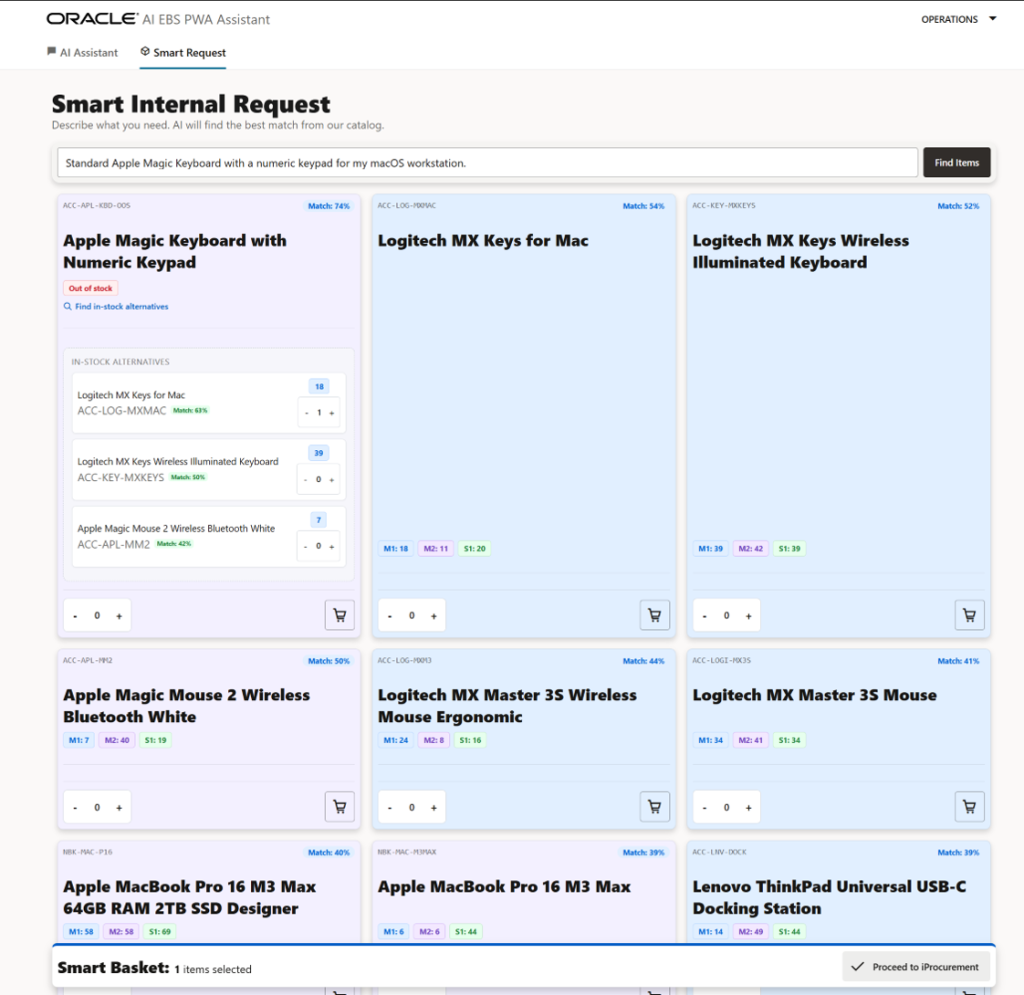
As a result, it proactively presents high-quality alternatives, such as the Logitech MX Keys for Mac, directly in the main search results. The system anticipates the ultimate goal, bridging the gap between brand loyalty and actual warehouse availability.
2. Smart Substitution: The “Out of Stock” Killer
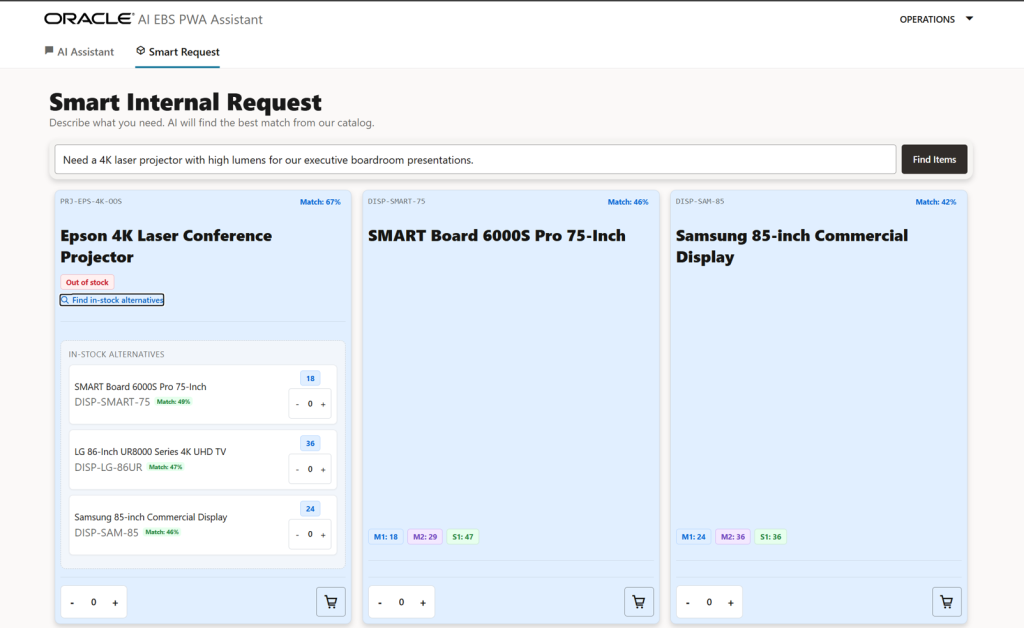
Even with proactive discovery, enterprise procurement often requires strict adherence to specific part numbers. When a required item—like a specific 4K boardroom projector—is flagged as “Out of stock,” the process usually grinds to a halt.
To resolve this, the architecture introduces a Smart Substitution workflow. Directly within the item card, users are presented with a “Find in-stock alternatives” action. With a single click, the system executes a localized semantic search against available inventory.
💡 Architectural Insight: Dynamic Vector Context
Notice the dynamic nature of the vector match percentages. The main search grid utilizes a Text-to-Item embedding to match the user’s natural language prompt. However, when a user clicks ‘Find in-stock alternatives’, the engine seamlessly switches to an Item-to-Item semantic similarity search. It uses the vector of the unavailable item itself as the anchor, recalculating distances to guarantee the closest functional hardware replacement rather than just matching the initial keywords.
How it delivers business value:
- Contextual Accuracy: It understands that the ultimate goal is “large-format boardroom presentations.” Instead of failing when exact projector models are unavailable, it instantly curates a diverse spectrum of functional equivalents—offering an interactive SMART Board, a large-format UHD TV, and a Commercial Display.
- Zero API Latency & Cost: Unlike naive AI implementations that constantly query external Large Language Models, this architecture leverages pre-calculated vector embeddings stored natively within the database. Finding an alternative is a pure mathematical operation inside Oracle 26ai. It happens in milliseconds and consumes zero external API tokens.
3. Contextual Workspace Assembly: Thinking in Roles, Not SKUs
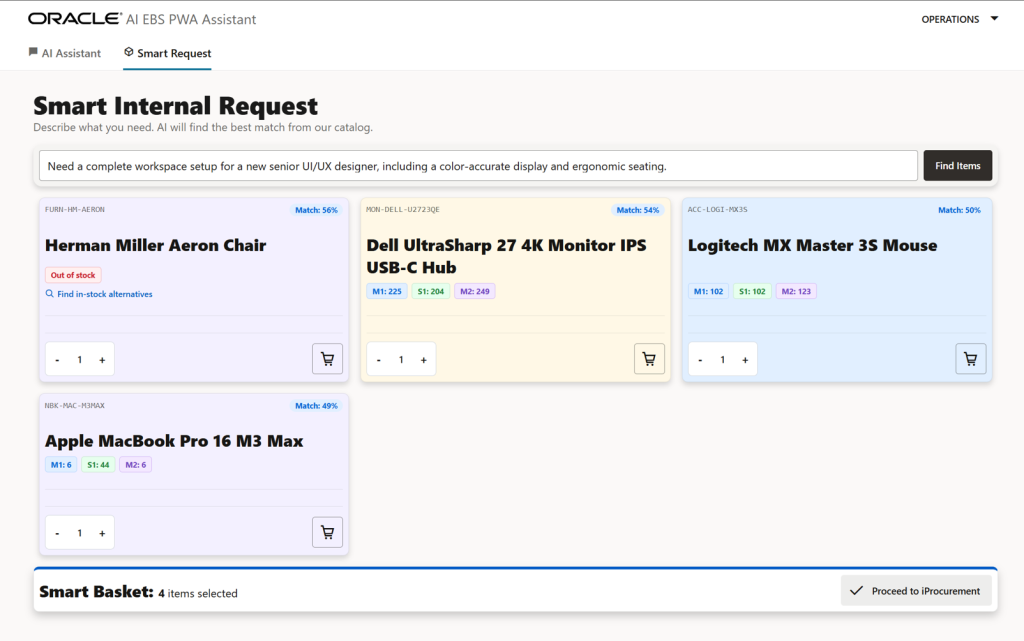
When HR or IT departments onboard a new employee, they don’t think in individual part numbers; they think in functional roles. Traditionally, requesting a complete setup requires searching through four or five different catalog categories (Laptops, Monitors, Peripherals, Furniture), which is time-consuming and prone to compatibility errors.
Here, the synergy of GenAI and Vector Search shines. A GenAI model instantly parses the natural language prompt, breaking it down into distinct hardware requirements. Simultaneously, the native vector engine executes localized searches against available inventory to find the exact, in-stock SKUs that match those requirements. By design, this workflow curates a complete, role-specific bundle in milliseconds, reducing the onboarding procurement process from hours of manual catalog browsing to a single query.
Even if a specific item within the bundle is marked as ‘Out of stock’ (like the Aeron chair), the system allows the user to proceed with the internal requisition. This seamlessly triggers a standard PR-to-PO flow or an Internal Order (IO) in the backend, maintaining the user’s workflow without disruption.
4. The Zero-State Experience: Predictive & Trending Procurement
In the consumer e-commerce world, the best search experience often happens before a single letter is typed. This philosophy translates seamlessly into the Enterprise ERP environment.
Upon opening the procurement PWA, users aren’t just faced with an empty search bar; they are greeted with a dynamic “Trending” section. By analyzing historical procurement data, departmental patterns, and request frequencies within Oracle 26ai, the system proactively surfaces high-turnover items.
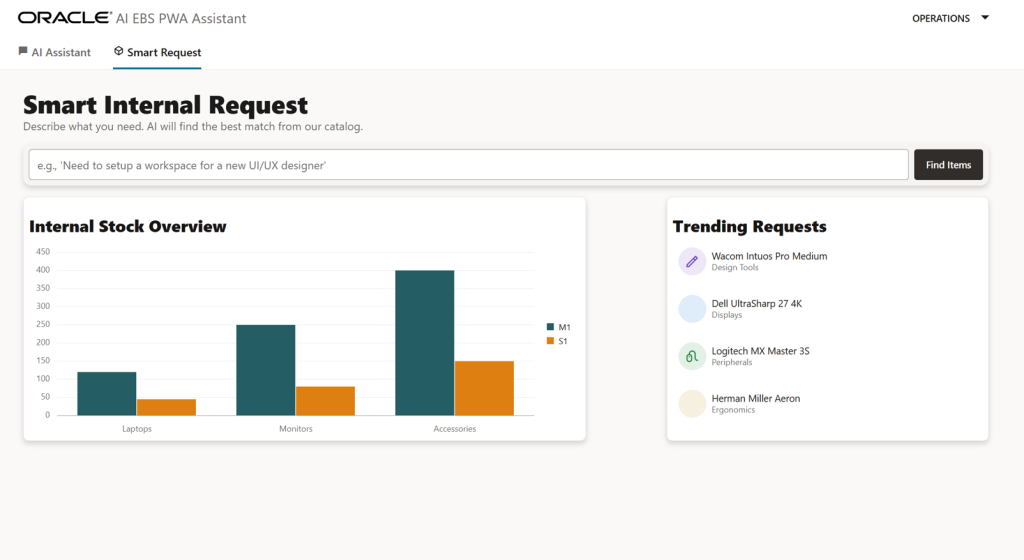
This completely eliminates friction for routine requests. If the data shows that 80% of new hires need the same standard-issue IT accessories, the system ensures those items are exactly one click away. It transforms a tedious catalog search into a simple, single-click confirmation.
Consumer-Grade UX in an Enterprise Reality
The best AI engine is useless if buried in a clunky interface. By wrapping this hybrid architecture in a modern PWA, the experience becomes frictionless.
When a user clicks to find an alternative, they aren’t redirected to a complex filtering screen. The semantic matches expand smoothly inline. Users see the match percentage, real-time multi-org warehouse balances (e.g., across M1 and S1 facilities), and can adjust quantities using a custom stepper—all without losing their context. It’s an e-commerce-grade experience built on top of a robust ERP foundation.
Modernize, Don’t Replace
Ripping and replacing an established ERP system is a multi-year, high-risk endeavor. But the user experience and procurement efficiency do not have to remain trapped in the past.
By layering a Hybrid RAG architecture over an existing enterprise ecosystem, organizations can unlock a consumer-grade, intelligent procurement experience in a fraction of the time. The intelligence is already hidden within the Master Data—it simply needs the right engine to surface it.
It’s time to move past manual catalog browsing and failed exact-match searches. It’s time to empower the workforce with systems that understand their intent, not just their keystrokes.
For IT and business leaders exploring ways to modernize an Oracle EBS architecture or experimenting with native vectors in Oracle 26ai, bridging the gap between semantic AI and strict enterprise heuristics is the next critical step.

Dmitry Borisov
Dmitry Borisov is an Oracle Solution Architect and recognized Oracle ACE Associate specializing in enterprise system modernization. As a leading industry expert, he pioneers the integration of Hybrid Vector Search, Generative AI, and Progressive Web Apps (PWA) into established enterprise ecosystems. His architectural methodologies enable large-scale organizations to achieve consumer-grade digital transformation without the high risk of replacing their core ERP foundations.