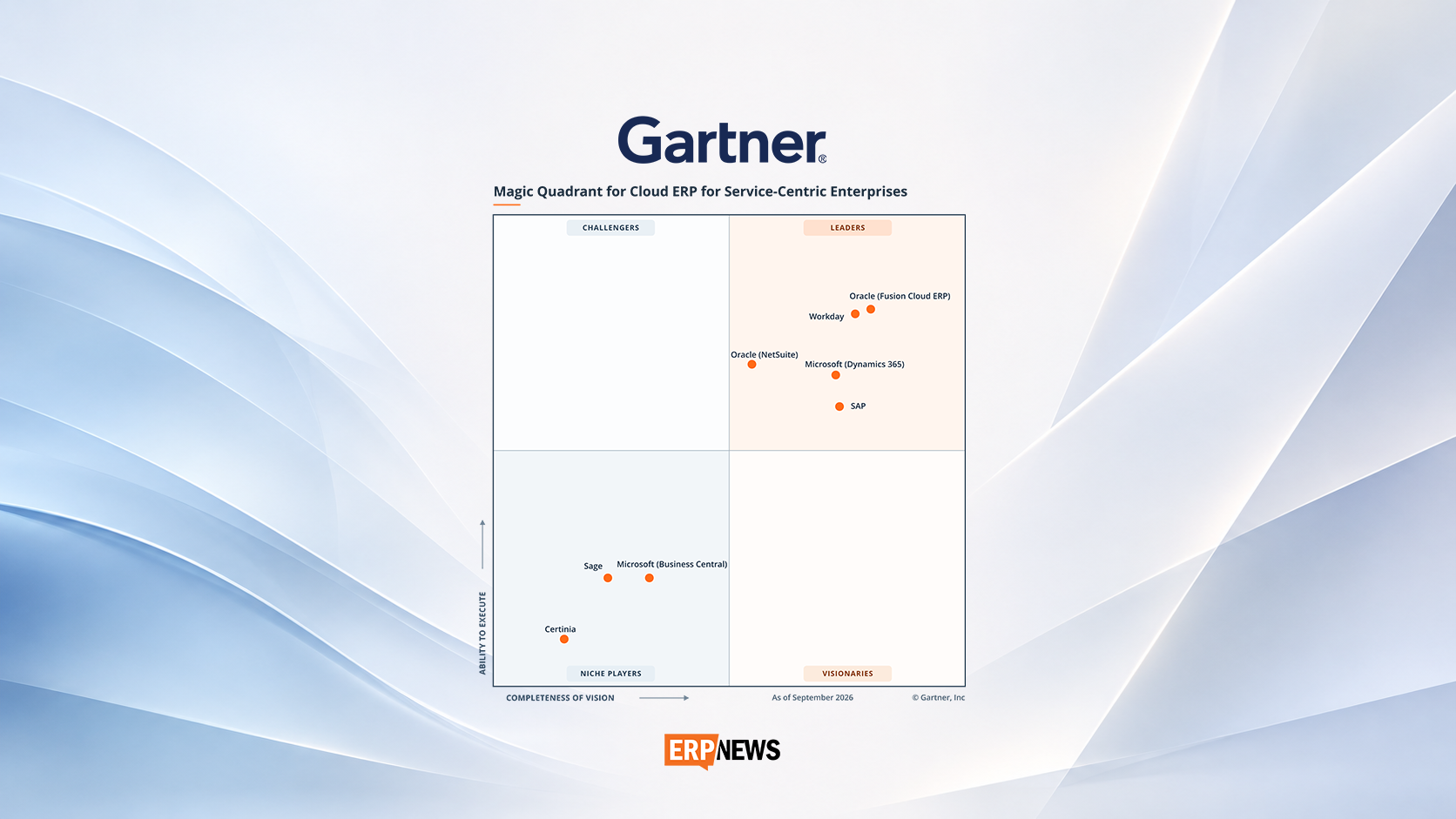
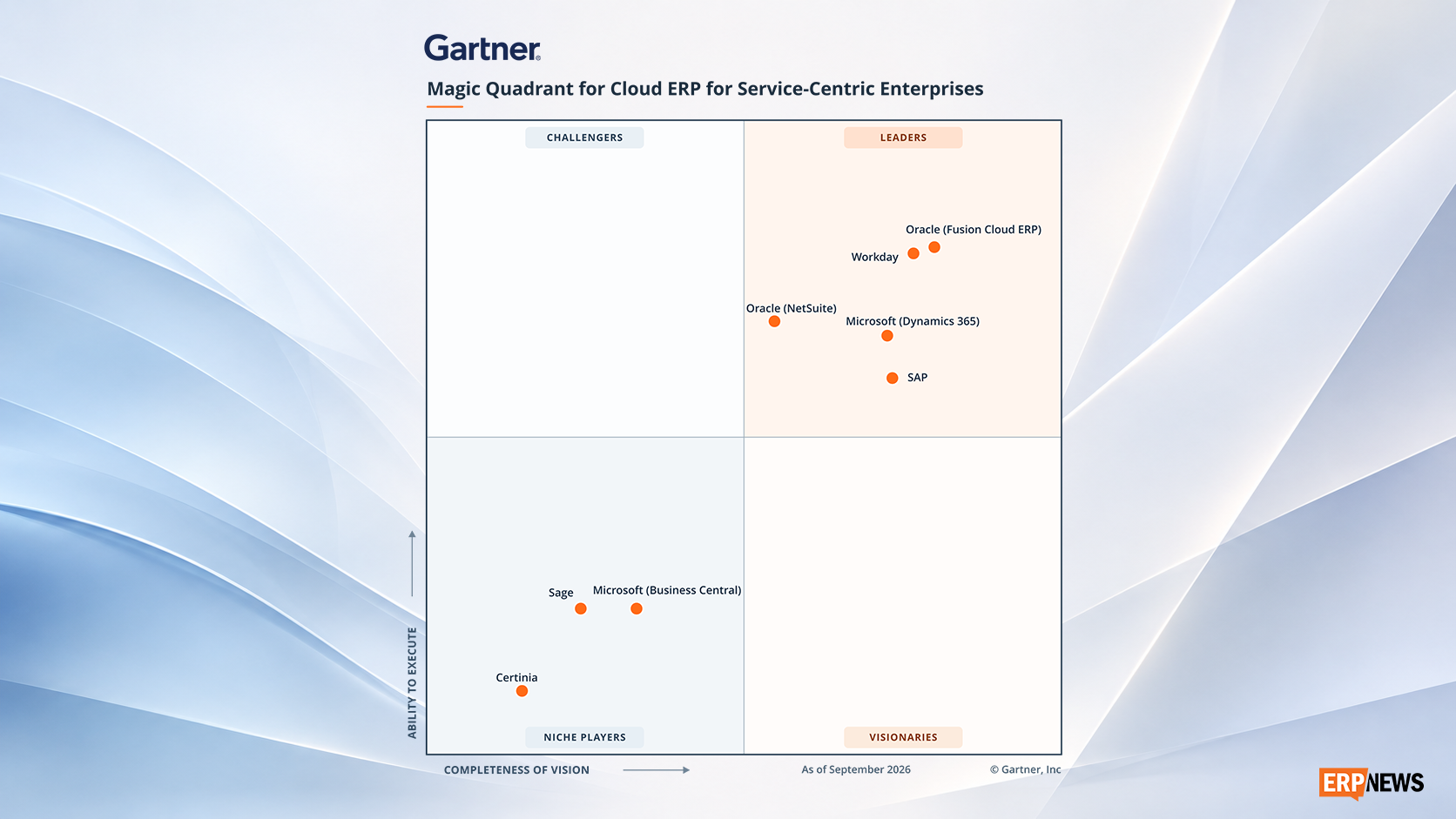
Gartner placed five of eight offerings in the Leaders quadrant of its 2026 Magic Quadrant for Cloud ERP for Service-Centric Enterprises, published November 2. Oracle Fusion Cloud ERP was highest and farthest right on the chart, with Workday close behind on both axes. Oracle NetSuite, Microsoft Dynamics 365, and SAP Cloud ERP completed the Leaders group.
Certinia, Microsoft Dynamics 365 Business Central, and Sage Intacct were placed in Niche Players. The Challengers and Visionaries quadrants were empty. Gartner added or dropped no entries this year.
The placements cover products with different starting points. Workday brings finance and workforce management together. Certinia focuses on the life cycle of a client engagement, from sales and staffing to project accounting. Sage Intacct starts with accounting and adds industry-specific functionality. Those differences help explain where a service business may need a partner product to complete a workflow, even when the ERP covers its core finance requirements.
What Gartner evaluated
Gartner’s service-centric evaluation covers finance and project accounting, order-to-cash, source-to-pay, core HR, and capabilities specific to service industries. Depending on the business, those capabilities can include professional services automation, recurring billing, project management, or services procurement. The scope also includes embedded analytics, conversational AI, and foundational support for agents. More advanced autonomous workflows sit in the optional category.
The methodology allows integrated partner capabilities under specified conditions, including predefined workflows and vendor-supported integration technology. As a result, a product can qualify while relying on another supplier for functions such as payroll or procurement. Gartner says it evaluated finance, HR, order-to-cash, procurement, and operations separately before combining the results. Its evidence included interactions with more than 1,000 end-user clients on ERP strategy since 2025, alongside demos, survey material, and customer inquiries.
Where the five Leaders stand out
Workday Cloud ERP
Gartner highlighted Workday’s shared data model for finance, HR, talent, and skills. A services firm can use that foundation to connect workforce planning with labor costs and project demand. The report also pointed to Workday’s Apache Iceberg-based data sharing, its use of Sana to coordinate Workday and third-party agents, and a Flex Credits model that lets customers pilot AI capabilities before production use starts drawing down credits.
Gartner flagged two dependencies that matter to multinational services businesses. Workday still relies on third parties for native payroll gaps in markets including Germany, Brazil, and India. Complex, high-volume consumer billing and collections can also require external products. A company assessing Workday for workforce planning should price the payroll and billing integrations it expects to operate alongside the suite.
Oracle Fusion Cloud ERP
Gartner credited Oracle for moving agent capabilities into general availability during the evaluation, including its Payables Agent. It also highlighted the integration of finance, projects, procurement, and workforce management with Oracle’s platform for extensions and automation. For a service organization with several operating units, that scope can support shared financial and procurement processes alongside local or industry-specific workflows.
Gartner identified pricing and delivery as areas to examine in detail. Some AI functionality is included, some is metered, and some development capabilities may be separately licensed. The analysts also cited customer concerns about renewal predictability when initial discounts expire. Country-specific interfaces or specialist industry extensions can require additional partner expertise, with implications for implementation and support costs.
SAP Cloud ERP
Gartner evaluated the public-cloud offering formerly called SAP S/4HANA Cloud Public Edition. It highlighted SAP’s Universal Journal as the accounting foundation for agents that work within financial transactions. The report identified the Accounting Accruals and Receivables/Payables Clearing agents as generally available in recent release waves. It also credited the SAP Knowledge Graph for providing the business context those tools can use.
Some cross-application workflows in SAP’s broader automation strategy depend on other SAP products and SAP Business Technology Platform. Gartner also pointed to Digital Access licensing, which can charge by the volume of certain documents created by external applications or automated tools. For a global service business, the questions are which transactions cross that licensing boundary and which reference customers run the public edition at comparable scale. Gartner says adoption has been concentrated among midsize companies and subsidiaries in two-tier deployments.
Microsoft Dynamics 365
Gartner highlighted the combination of Dynamics 365 Project Operations, Finance, and Field Service for quoting, resource allocation, delivery, and financial management. It also cited Microsoft’s Azure platform and open agent framework, which allow companies to extend workflows through tools such as Copilot Studio, Power Platform, and Dataverse while using ERP access controls.
The report identified a combination of subscription tiers, workflow charges, storage fees, and consumption-based credits for autonomous agents that can complicate cost forecasts. It also noted that some larger enterprises had difficulty finding global customer references. During the evaluation, Gartner identified capabilities such as analytics protocol servers and native expense management as being in preview. Buyers with a global rollout should confirm both feature availability and the performance of the proposed configuration at their transaction volumes.
Oracle NetSuite
NetSuite’s Leader placement covers small through upper-midsize service businesses. Gartner highlighted the unified application architecture behind NetSuite Next, which uses Ask Oracle and SuiteAgents to bring conversational access and guided actions into ERP workflows. It also noted that customers can connect external AI through the NetSuite AI Connector Service while using NetSuite’s roles, permissions, and audit trails.
Gartner found fewer demonstrated industry-specific workflows than at several larger providers and limited public evidence on customer adoption of embedded AI. It also flagged pricing that varies with factors such as user count, data volume, infrastructure, and support tier. A buyer with complex project billing or service delivery should ask to see those workflows in the proposed configuration and establish how the price changes as the business grows.
Three Niche Players with distinct service use cases
Certinia
Certinia builds its finance, professional services, and customer success products on Salesforce. Gartner credited the way it connects sales estimates and statements of work to resource planning, project accounting, and revenue recognition. It also highlighted Certinia’s extensibility and quarterly upgrade model, which lets customers choose when to activate some new functionality.
The same architecture makes the partner requirements important. Certinia relies on third parties for core HR and payroll and uses specialist providers for functions such as e-invoicing, supplier payments, and tax reporting. Gartner also identified the Staffing Agent and Project Assistant Agent as being in extended early adopter programs during the evaluation. For a services firm choosing Certinia for project delivery, those dependencies determine how much of staffing, payroll, and compliance can run inside the proposed solution.
Microsoft Dynamics 365 Business Central
Gartner highlighted Business Central’s large small-business ecosystem, integration with Microsoft 365, Power BI, Teams, and Power Platform, and early access to Microsoft’s ERP agent capabilities. Its native finance, project, and service management functions give smaller service businesses a starting point.
Gartner found less depth in native functionality for complex services operations. Professional services firms, construction businesses, and nonprofits may need AppSource products to cover industry workflows, and overlapping partner offerings can make selection more involved. As operations grow, buyers need to consider who will support those extensions and how they affect upgrades. Gartner says Microsoft declined to provide supplemental information or review the draft, so it relied on other sources for the evaluation.
Sage Intacct
Gartner highlighted Intacct’s multientity accounting, multicurrency consolidation, and embedded controls such as general ledger outlier detection and accounts payable line matching. It also cited industry capabilities such as construction retainage, work-in-progress scheduling, and nonprofit grant management. Full source-to-pay procurement, HR, and global payroll depend on partners, and Gartner found that advanced automation and AI availability was concentrated in Sage’s core markets.
Gartner flagged extended AI previews, and Sage’s November 6 release changed the status of one capability. Sage Intacct 2026 Release 4 lists the Finance Intelligence Agent, which answers natural-language questions about financial data, as generally available in Australia, Canada, Singapore, South Africa, the United Kingdom, and the United States. Custom approval workflows for invoices and Order Entry transactions remain in Early Adopter, as detailed in ERP News’ coverage of Sage Intacct Release 4. Gartner says Sage declined to provide supplemental information or review the draft, so its assessment used other sources.
Infor and Kingdee were honorable mentions
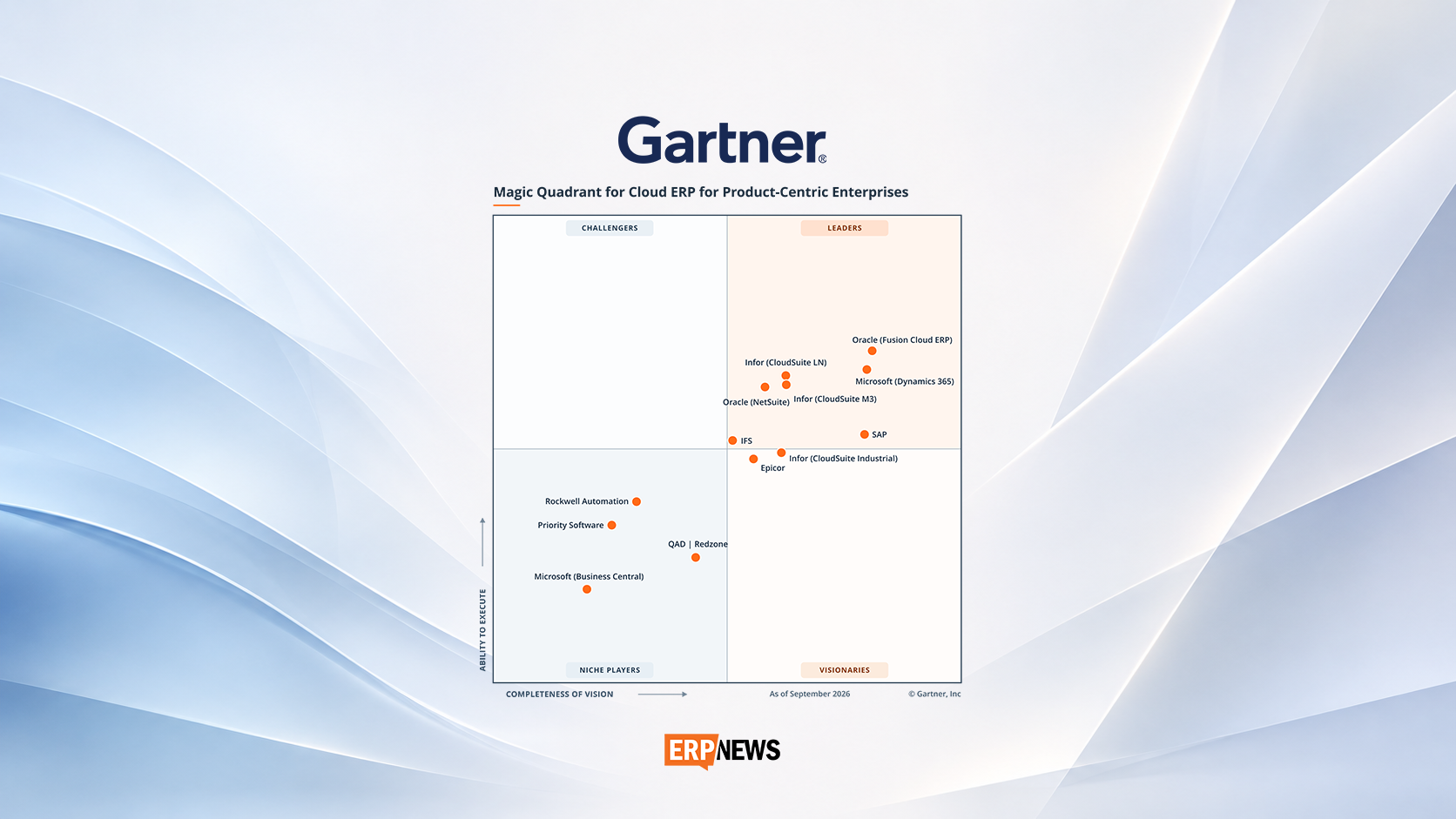
Gartner listed Infor and Kingdee outside the formal service-centric evaluation. It cited Infor’s presence in U.S. healthcare and the public sector, while describing product-centric industries as its primary focus. Gartner cited Kingdee’s presence in China and parts of Asia and said its global footprint fell short of the report’s inclusion requirements.
Gartner’s companion Critical Capabilities study examines functions such as finance, HR, and procurement in more detail across different enterprise sizes. For a project-based business, a selection demo can start with a signed statement of work and follow it through staffing, time entry, a scope change, invoicing, and revenue recognition. A subscription business can follow an amended contract through recurring billing and collections. In both cases, the workflow shows which vendor owns each handoff and where additional licensing, support, or integration comes into play.
Sources
- Gartner, Magic Quadrant for Cloud ERP for Service-Centric Enterprises (Johan Jartelius, Dixie John, Tomas Kienast, Greg Leiter, Sam Grinter, and Chaithanya Paradarami, November 2, 2026)
- Gartner reprint of the service-centric report
- Gartner, Critical Capabilities for Cloud ERP for Service-Centric Enterprises
- Sage Intacct 2026 Release 4 notes

ERP News Editorial Team
The ERPNews Editorial Team covers global developments in ERP (Enterprise Resource Planning), enterprise software, cloud platforms, AI, automation, and digital transformation, providing independent news and editorial analysis for senior business and technology leaders. Our reporting focuses on market signals, strategic shifts, and enterprise impact across the ERP and enterprise technology ecosystem.
For editorial inquiries, please contact:
📩 [email protected]