
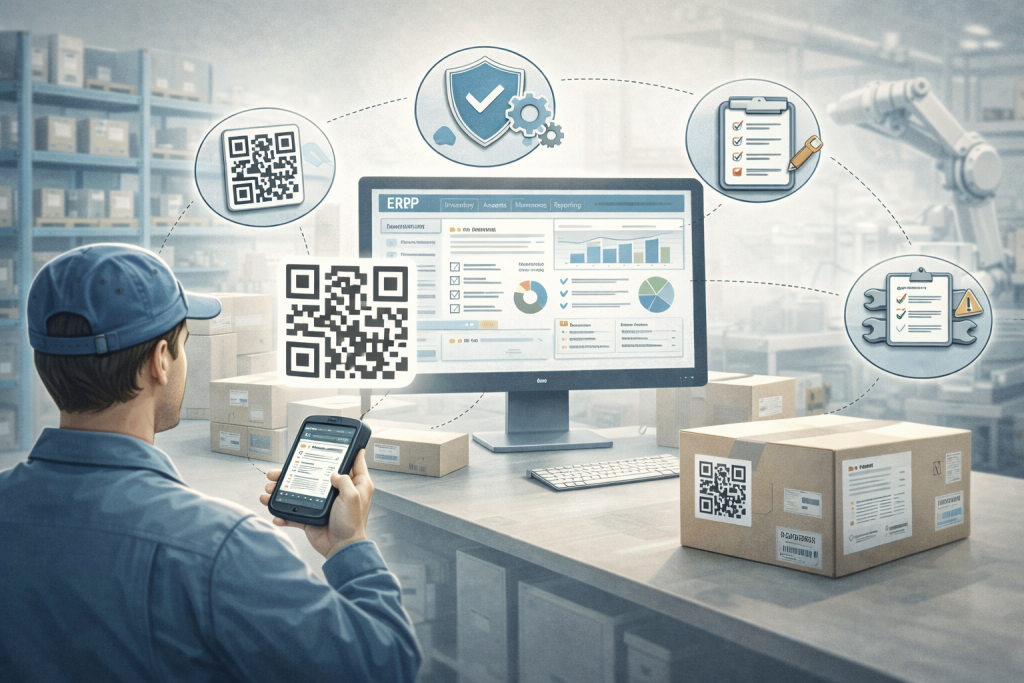
Enterprise Resource Planning systems sit at the core of modern organisations. They manage inventory, assets, workflows, compliance and reporting across departments. Yet for many employees, accessing the right ERP data at the right moment is still harder than it should be.
The problem is rarely the ERP itself. It’s the last mile: how people interact with complex systems in physical, operational environments.
This is where QR codes are quietly making a difference. By combining ERP platforms with tools like a QR Code Generator, organisations are simplifying how data is accessed across warehouses, offices, production floors and field operations without changing their core ERP architecture.
The ERP Accessibility Gap
ERP systems are designed for structure and control. They are powerful, configurable and secure. But they are not always convenient in real-world contexts.
Common challenges include:
- Operators needing quick access to item or asset data
- Maintenance teams looking for the latest procedures
- Warehouse staff verifying inventory or batch information
- Auditors requesting documentation on the spot
- Field teams working without laptops or full system access
In many cases, the data exists but not where or when it is needed.
QR Codes as a Practical Access Layer
QR codes act as a lightweight interface between the physical world and ERP data. Placed on assets, storage locations, documentation or equipment, a single scan can retrieve the most relevant information instantly.
The key advantage is simplicity:
- No need to navigate ERP menus
- No manual searching
- No additional devices or apps
Users scan a code and land exactly where they need to be.
Because the QR code points to a digital destination, the ERP system remains unchanged. The code simply improves access to what already exists.
Typical ERP Use Cases for QR-Based Access
Asset and Equipment Management
QR codes attached to machinery or assets can link directly to:
- ERP asset records
- maintenance schedules
- service history
- compliance documentation
- spare parts lists
This reduces downtime and avoids outdated paper manuals.
Warehouse and Inventory Operations
In storage and logistics environments, QR codes help teams:
- check item details and locations
- confirm batch or serial information
- access handling instructions
- verify stock movements
All without logging into a desktop system.
Manufacturing and Production
On the production floor, QR codes support:
- standard operating procedures
- work instructions
- quality checks
- version-controlled documents
This ensures operators always follow the latest process, even as procedures change.
Compliance and Auditing
During audits or inspections, QR codes allow immediate access to:
- certificates
- approvals
- revision histories
- supporting documentation
This shortens audit cycles and reduces manual document preparation.
Field Service and Mobile Teams
For organisations with distributed teams, QR codes simplify access to ERP-linked data without requiring full system access on every device.
Why Dynamic QR Codes Matter in ERP Environments
In enterprise systems, data changes frequently. Static references quickly become outdated.
Dynamic QR codes solve this by separating the physical code from the destination. The same code can always point to the most current version of a record, document or dashboard.
This allows IT and operations teams to:
- update destinations centrally
- avoid reprinting labels or documents
- maintain a single source of truth
- support multiple ERP environments or versions
For large ERP landscapes, this flexibility is essential.
Security and Access Control Considerations
QR codes do not replace ERP security. They complement it.
Access can still be managed through:
- authentication layers
- role-based permissions
- secure portals
- internal VPNs or SSO
The QR code simply provides a faster entry point to the controlled environment.
From a governance perspective, this approach maintains system integrity while improving usability.
Operational Benefits Beyond IT
While QR integration often starts as an IT or operations initiative, the benefits extend across the organisation:
- Faster task execution
- Fewer errors caused by outdated information
- Reduced training time for new employees
- Less reliance on printed documentation
- Improved cross-departmental consistency
Over time, these small efficiencies compound especially in large-scale ERP deployments.
Managing QR Access at Scale
As organisations expand QR usage across assets, locations and processes, central management becomes critical. Platforms like Trueqrcode are commonly used to manage multiple QR codes, update destinations and monitor usage without adding complexity to the ERP itself.
This keeps the ERP system focused on what it does best, while QR technology handles access and usability.
Conclusion
ERP systems are not becoming less complex but the way people access them can become much simpler.
QR codes offer a practical, low-barrier solution to one of the most persistent challenges in enterprise environments: getting the right data to the right person at the right moment.
By acting as a bridge between physical operations and digital systems, QR codes are helping organisations unlock more value from their existing ERP investments without restructuring platforms or processes.
In modern ERP strategies, simplicity is not a compromise.
It is an advantage.