Enterprise planning and reporting depend on how quickly teams can make sense of the data behind them. But as financial, operational, and workforce information grows in volume and complexity, the methods used to interpret that data have changed far more slowly. Many FP&A teams still spend 40–50% of their time collecting, checking, and reconciling numbers — work that delays insights rather than enabling them.
That gap between the pace of business data and the pace of analysis is where AI is increasingly starting to make a practical difference. Its value in finance is not abstract automation, but the ability to turn raw information into explanations, drivers, scenarios, and forward-looking signals with far less manual effort. This shift becomes especially visible inside modern enterprise platforms, where intelligence is embedded directly into the systems that produce and connect operational, financial, and people data.
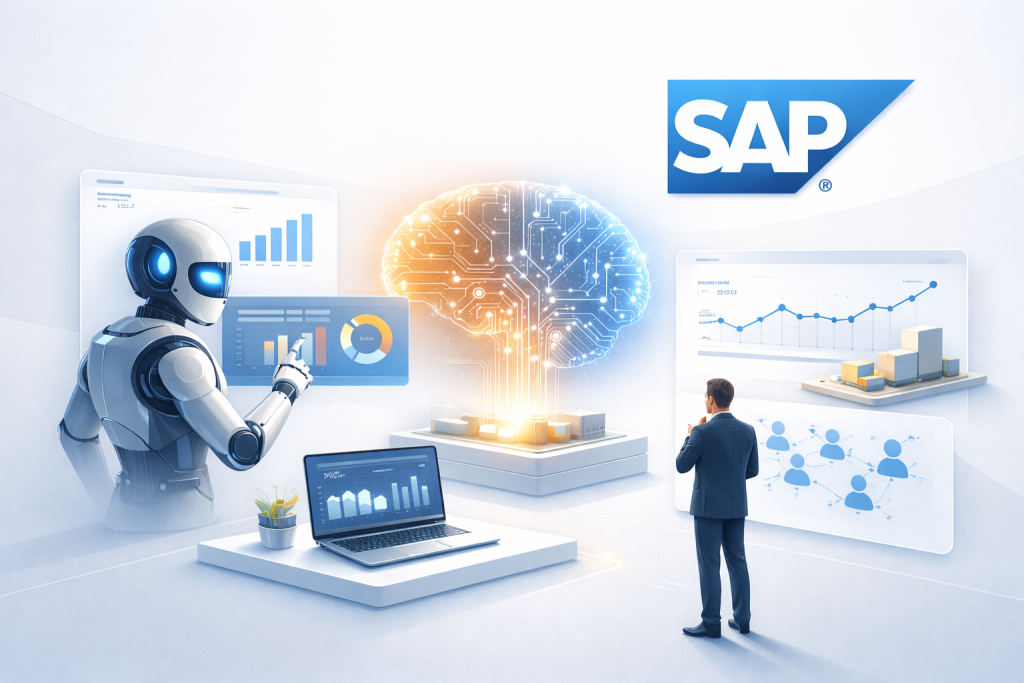
SAP offers one of the most developed examples of this approach, bringing AI into the daily flow of planning, reporting, and decision-making. While the capabilities continue to evolve quickly, looking at how this intelligence layer works across SAP’s ecosystem today still provides a practical view of what AI-enabled planning and reporting look like in real use — and what it means for finance teams that are modernizing their processes.
SAP approaches this shift through a layered intelligence model — beginning with the way users interact with data and building downward into the systems that understand daily operations and support advanced planning.
Joule: SAP’s gateway to AI-enhanced planning, reporting, and broader enterprise workflows
In most companies, planning and reporting run across multiple disconnected systems. You have the main ERP system, a separate planning tool for budgets, spreadsheets for month-end close, and another dashboard for workforce or operations data. Teams spend too much time jumping between them, trying to reconcile numbers and waiting for reports that are already out of date — a challenge that becomes even harder as tools and data flows continue to evolve.
That gap you can close with Joule. It’s an AI copilot that acts as a unifying layer across everything.
What is Joule?
Joule is a generative AI assistant that lives inside SAP’s core products, including S/4HANA, SAP Analytics Cloud, and SuccessFactors. It sits on top of their unified data foundation and helps deliver insights that reflect the full enterprise context. SAP calls it “AI that fits into the flow of work”, meaning it provides a single, conversational entry point to the information and actions people need, without constant switching between systems.
Joule is designed to simplify how teams work with data. It offers features like:
- Insight cards and summaries: Joule adds written context around the numbers to highlight trends or variances.
- Natural-language queries: You can just ask questions like “Why did our margin drop in Q2 in Region X?” and then follow up with more questions to explore the data, without going through the reports yourself.
- Proactive action bar: Instead of waiting for someone to notice a problem, Joule makes suggestions for next steps or tasks.
SAP is continuing to expand what Joule can do, not only through interface updates but through deeper improvements to its AI foundation. One of the biggest steps is the new RPT-1 family of models, built specifically for relational business data and designed to make Joule’s insights faster and more accurate. SAP is also adding integration with Perplexity AI to weave in external data and market context, along with smarter, context-aware search that helps Joule understand the task at hand and respond more naturally as these capabilities evolve.
Joule’s role in the ecosystem
You can think of Joule as the entry point to SAP’s intelligence layer. It makes it easier for people to get to the right insights and creates a more connected experience across finance, HR, and operations. Once teams start using Joule, they naturally move deeper into the system. That progression takes them from embedded analytics in S/4HANA to advanced planning tools such as SAC and SuccessFactors.
The foundation of data and process still matters. Once that’s in place, AI removes much of the friction and busywork to make planning and reporting faster, simpler, and easier to use.
Embedded AI in S/4HANA: Built-in intelligence for reporting
Where Joule is a natural starting point with AI, SAP S/4HANA has AI built directly into the product. The same platform that processes transactions also learns from them (through machine learning and automation) to interpret patterns, flag anomalies, and support better decisions in real time.
S/4HANA’s embedded AI provides real-time operational intelligence, supporting tasks such as:
- Anomaly detection: The system automatically flags unusual activity or data that falls outside expected patterns across operations and finance.
- Predictive forecasting: Cash flow, demand, and asset depreciation are projected directly inside the ERP instead of in separate BI tools.
- Automated variance analysis and commentary: Deviations appear as they happen, so teams don’t have to wait until the month-end close to understand what changed.
- Embedded analytics: With S/4HANA’s in-memory architecture, reports refresh instantly and stay connected to live data (versus static or outdated reports).
It cuts out much of the waiting that slows finance down. Reports are updated as transactions happen, and variances are explained in context instead of manual checks. With operational and financial data in one place, planning can finally become a continuous process. And teams can move straight into forecasting and scenario modeling instead of spending time cleaning and combining data.
S/4HANA’s AI role in the ecosystem
Embedded AI gives the operational layer of intelligence to handle day-to-day analysis. But for advanced modeling, scenario planning and workforce analytics, finance teams still need to look to specialized tools. Transactions feed the system from which the system that, in turn, generates insights, and other modules turn those insights into business strategy.
AI features for planning and reporting in SAP products beyond S/4HANA
While the basics are covered inside S/4HANA, more advanced planning and analysis often rely on AI-supported features available in other SAP products.
1) AI features within SAP Analytics Cloud (SAC)
SAC acts as a central space for planning, forecasting and reporting. It’s designed for collaboration as much as analysis. Different teams can work from the same data without losing context. AI is meshed in the experience:
- Just Ask (supported by your Joule integration) lets users explore data in plain language.
- Smart Predict takes care of forecasting and regression analysis without custom modeling.
- Smart Insight highlights main influencers on the selected key figures, based on the data available in your system
- Compass lets teams test different scenarios to see how multiple factors interact.
SAC works for every level of decision-making all the way from operational dashboards to board-level reviews through the Digital Boardroom. Because it connects directly to S/4HANA or data-warehouse sources, the data is live. This, in turn, creates a much faster and more fluid planning cycle.
2) SAP SuccessFactors – Workforce Planning & People Analytics
Workforce planning has always been a weak spot in enterprise systems. Headcount, hiring, and skills data often sit apart from financial and operational planning, even though they contribute to business performance. Currently, only 12% of organizations can actually access this data across teams.
SuccessFactors extends SAP’s cloud ecosystem into the people’s side. Rather than acting as a standalone HR system, it links talent management, succession planning, and analytics to give organizations a more complete view of how staffing decisions shape long-term results. Its AI features play a key role in making that possible:
- Predictable Analytics anticipates attrition risks and identifies hiring needs to address skill gaps before they affect operations.
- Scenario Modeling lets HR and finance teams test different workforce plans to see how hiring, restructuring, or succession choices might play out.
- Natural language queries (via SAC integration) make it easy to explore the ins-and-outs of workforce data and how it connects to key metrics.
- Anomaly detection looks for unexpected patterns like turnover spikes or role imbalances.
- Data-driven workforce expenses planning reduces time spent on the planning process, and increases plan accuracy, using Success Factors and S4HANA data as a basis for plan generation.
SuccessFactors gives leaders a clearer sense of where pressure is building in the workforce and ties that information back to business strategy and outcomes. Instead of reacting after the fact, teams can plan around real trends in the workforce and make adjustments while there’s still time to change the outcome.
AI’s impact on enterprise planning & reporting
Dealing with constantly changing data has long made enterprise planning difficult, especially with the bottlenecks of manual consolidation and static planning cycles. SAP’s AI capabilities help ease this pressure by gradually reducing the amount of manual work required and giving teams clearer, more timely insights as the technology continues to evolve.
Within that broader shift, Joule lowers the barrier between people and data, giving users a single way to tap into AI across the SAP landscape. Within S/4HANA, embedded intelligence helps keep daily operations aligned with the financial reality. And specialized tools like SAC and SuccessFactors carry that intelligence further into the key domains of forecasting, modeling, and workforce planning.
With Joule and embedded AI, organizations can better manage change. Planning becomes more responsive, and decisions start to reflect the present, not the past. Enterprise systems are evolving from systems of record into systems of intelligence.

Pavel Ramanouski
Pavel Ramanouski,Head of SAP BI and EPM practice at ACBaltica, is an experienced SAP BI Consultant, Architect, and EPM Lead with over 15 years of experience in the consulting industry. He specializes in designing and implementing business intelligence and performance management solutions that support strategic and operational decision-making.
Pavel acts as a trusted advisor to clients, guiding them through the full project lifecycle — from strategy and architecture design to hands-on development and deployment. His expertise spans the SAP BI ecosystem, including SAP Business Data Cloud, SAP BW and BW/4HANA, SAP Analytics Cloud (SAC), and Business Planning and Consolidation (BPC).
He excels at translating complex business requirements into clear, practical technical roadmaps aligned with organizational goals, helping companies turn data into a strategic asset.