- Three new enterprise storage systems – IBM FlashSystem 5600, 7600, and 9600 – significantly reduce storage management efforts
- FlashSystem.ai brings AI agents to storage arrays as co-administrators
- Fifth-generation FlashCore Module detects ransomware in under 1 minute, offers new advances in system resiliency and data management
IBM today unveiled the next generation of IBM FlashSystem, co-run by agentic AI, ushering in a new era of autonomous storage. By enhancing FlashSystem’s existing AI capabilities with agentic AI, IBM is redefining resilience through sustained protection, autonomous threat analysis, and customized recovery recommendations. Clients can now turn storage into an always-on layer of intelligence, enabling reliable and secure storage operations that can reduce the manual effort of storage management by up to 90%.1
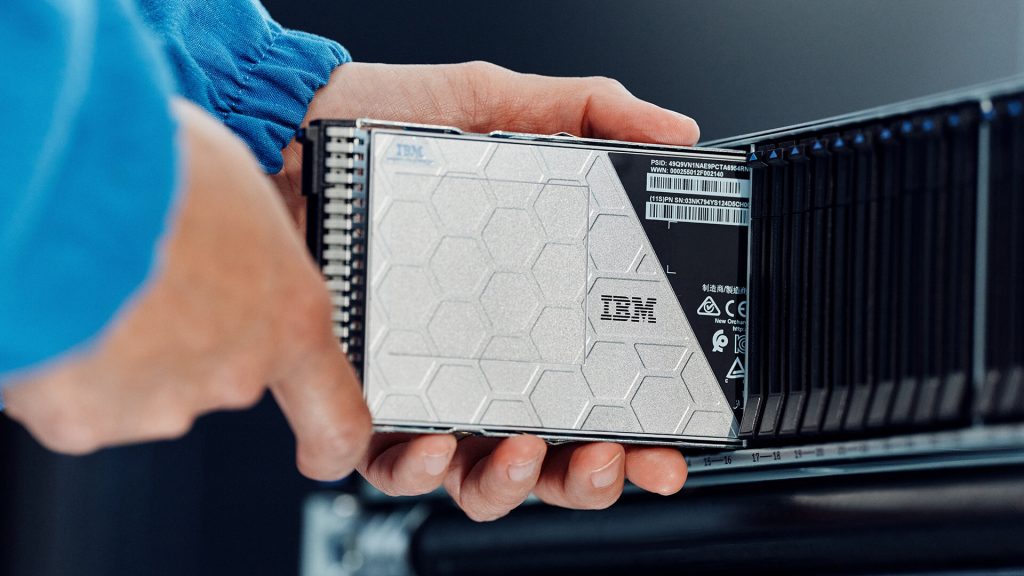
The new portfolio includes:
- Three new systems – the IBM FlashSystem 5600, 7600, and 9600 – which deliver up to 40% greater data efficiency for improved capacity footprint and performance, compared to the previous generation.2
- FlashSystem.ai, a new set of intelligent data services that help administrators manage, monitor, diagnose, and remediate issues across the entire data path.
- The new fifth-generation FlashCore Module all-flash drive, which is engineered to provide hardware-accelerated real-time ransomware detection, data reduction, analytics and operations, with advanced telemetry and consistently low latency at scale.
As companies increasingly integrate AI workflows into their operations, agentic AI has the potential to streamline the way IT teams work across the stack. In fact, 76% of executives responding to an IBM IBV study say their organizations are developing, executing, or scaling proof-of-concepts that automate intelligent workflows through self-sufficient AI agents.3 In tandem, enterprise IT teams continue to face accelerated data growth, expanding cyber threats, and tightening compliance requirements. These roadblocks have created a need for intelligent, autonomous storage solutions.
“The next-generation IBM FlashSystem elevates storage to an intelligent, always-available layer, where autonomous AI agents continuously optimize performance, security, and cost without human intervention,” said Sam Werner, GM of IBM Storage. “The updated portfolio marks the beginning of an autonomous storage era, where FlashSystem becomes a strategic AI partner that can help IT leaders ensure optimal, secure performance for every workload they run.”
Meet the New Generation
Three simultaneous model launches make this the most significant IBM FlashSystem launch in the last six years, with a series of new models developed for a variety of business needs, including:
- IBM FlashSystem 5600, ideal for organizations that need enterprise-class capabilities in a compact footprint, provides up to 2.5 PBe of effective capacity in a single 1U system, setting a higher bar for storage density in the midrange market, and up to 2.6M IOPs. The ultra-dense 1U design is perfect for space-constrained environments such as edge locations, remote offices, and smaller data centers.
- IBM FlashSystem 7600, developed for organizations that need high performance and scalability for growing workloads, provides up to 7.2 PBe of effective capacity in a single 2U system and up to 4.3M IOPs. The 7600 is designed to handle large virtualized environments, analytics platforms, and consolidated applications that require greater capacity and faster response times.
- IBM FlashSystem 9600, built for enterprises running mission-critical operations that demand extreme performance and massive scalability, provides up to 11.8 PBe of effective capacity in a single 2U system with up to 6.3M IOPs. Typical use cases include core banking systems, ERP platforms, and AI-driven applications that require speed and advanced security. The FlashSystem 9600 reduces operational cost by as much as 57% via AI and consolidation compared to the previous generation.4
IBM FlashSystem reduces the required storage footprint by 30%-75%, depending on the model, through optimized placement and consolidation, compared to its previous generation.5 For the FlashSystem 7600 and 9600, clients also have the option to monitor and visualize system state information physically with new interactive LED bezels.
Flash Storage Meets AI
FlashSystem.ai brings AI-powered data services to clients through seamless, self-service operations that automate manual and error-prone tasks. IBM designed FlashSystem.ai to transform storage from a static repository into a self-improving system. With an AI model trained on tens of billions of data points collected through advanced telemetry and years of real-world operational data, the platform can execute thousands of automated decisions per day that previously required human oversight.
FlashSystem.ai not only automates many parts of storage management, but also quickly learns over time. This new agentic AI feature is built to adapt to application behavior in hours and designed to be significantly faster than template-based machines, suggesting performance improvements and explaining reasoning, while incorporating administrator feedback to tailor recommendations. FlashSystem.ai on the latest generation of FlashSystem models is engineered to cut audit and compliance documentation time in half through AI-generated, explainable operational reasoning.6 The newest generation of IBM FlashSystem runs client workloads with proactive tuning, intelligent placement of workloads for non-disruptive data mobility across storage devices, including third party storage arrays.
FlashCore Module Technology
All new FlashSystem models contain the fifth-generation FlashCore Module, a drive with up to 105TB of capacity and significant updates to efficiency and security. It also enables IBM FlashSystem models to compute complex statistics on every I/O using hardware‑accelerated analytics, designed to detect ransomware and anomalies rapidly without impacting system performance.7 Trained on tens of billions of data points collected through advanced telemetry and years of real-world operational data, the new IBM FlashSystem models’ threat detection can keep false positives to under 1%.8 The drive also provides AI-driven ransomware detection and alerting in under 60 seconds,9 as well as autonomous recovery actions at the hardware layer, making IBM FlashSystem among the most resilient storage offerings in the market.10
“New advanced AI capabilities to the IBM FlashSystem portfolio give customers mechanisms to automate optimal placement of enterprise workloads within the IBM storage system’s footprint, enhance security, and proactively address compliance requirements,” said Natalya Yezhkova, Research Vice President, Worldwide Infrastructure Systems, IDC. “These capabilities allow organizations to quickly react to changing business requirements through adaptive SLAs without additional burden on IT administrators.”
“More than three years ago, IBM began reshaping the storage landscape by introducing resiliency as a core capability, through innovations like Safeguarded Copy and built-in anomaly detection. Storage stopped being only about capacity and performance and started being about protecting data at its source,” said Nezih Boyacioglu, Business Development at Istanbul Pazarlama A.S. “Today, the rest of the industry is finally catching up to that vision, but IBM is already moving into the next era. With FlashSystem.ai, we’re moving from ‘built-in protection’ to ‘pervasive intelligence.’ It’s about more than just fast drives; it’s about combining human expertise with a system that learns, adapts, and gives organizations the confidence to move fast without looking over their shoulder.”
IBM Technology Lifecycle Services (TLS) uses AI-enabled monitoring, automated issue detection through Call Home, pre-code health checks, and priority support for critical issues to help identify and resolve potential system problems before they cause downtime.
The new FlashSystem portfolio will be generally available on March 6, 2026. To learn more about IBM FlashSystem, visit https://www.ibm.com/products/flashsystem
| 1 FlashSystem.ai can reduce storage management effort by up to 90% compared to doing those routine operations in a drive’s graphical user interface (GUI). Disclaimer: Based on internal, taskbased evaluations of representative routine operations (multivolume provisioning with Safeguarded Copy and DR policies) under labcontrolled conditions on latest generation FlashSystem models (5600, 7600, 9600) with FlashSystem.ai, versus the latest generation of IBM FlashSystem (5600, 7600, 9600) without FlashSystem.ai. Actual results vary by environment, integrations, policies, and user proficiency. |
| 2 Disclaimer: Illustrative comparison of compressiononly versus combined deduplication + compression achievable when using latest generation FlashSystem models (5600, 7600, 9600), subject to dataset characteristics. Ratios and performance vary with data type and workloads. Performance internal lab testing of FlashSystem 9600 versus FlashSystem 9500 under a 4 KB random write profile at comparable latency observed. Results are workloadspecific. |
| 3 IBM IBV Research Brief: Orchestrating Agentic AI for Intelligent Business Operations |
| 4 Disclaimer: Modeled comparison of FlashSystem 9600 versus FlashSystem 9500 at ~10 PB usable. Operational cost determined by an equal appropriation across admin labor, rack space (RUs), and energy. Inputs include ~50% admin effort reduction with FlashSystem.ai, ~67% RU reduction, and ~25–30% power reduction on latest generation FlashSystem models (5600, 7600, 9600). Results are illustrative; customer outcomes vary by rates, workloads, utilization, configuration, and policies. |
| 5 Disclaimer: Deduplication and compression data derived by using the latest report from IBM shipped FCMs and client systems that have been running from 3 months to 7 years as of January 2026. Result specific to the compared configurations and drive sizes. Max configuration for FS 9600 and FS 9500 on usable capacities with a 14+2 parity; savings vary when comparing other systems. Deduplication is confirmed with internal lab testing. |
| 6 Disclaimer: Based on FlashSystem.ai capabilities available on latest generation FlashSystem models, which can auto‑assemble evidence of configurations, protection policies, operational history, and risk posture to support audit preparation. |
| 7 Disclaimer: Describes latest generation FlashSystem models with FCM5 that compute per‑I/O statistics using hardware‑assisted analytics with real‑time model evaluation on array controllers. “without impacting system performance” reflects internal measurements under tested workloads. |
| 8 Disclaimer: False‑positive performance is based on models trained with recurring production telemetry, used to refine discrimination and reduce false positives on latest generation FlashSystem models (5600, 7600. 9600). This applies to the most recent Ransomware model (3.3) released on 4Q 2025. Data collected for 24 months. False positives measured over 3 months. |
| 9 Disclaimer: Internal experimentation by IBM Research has demonstrated detection of ransomware within 1 minute of the ransomware starting its encryption process. This experiment was done on a FlashSystem 5200 with 6 FCMs with the 4.1 firmware load. The 5200 had 8.6.3 GA level software loaded. The host connected to the 5200 was running Linux with XFS Filesystem. In this particular case, the IBM ransomware simulator called WannaLaugh was used. Underlying system must be compatible with FCM4.1 and version 8.6.3 GA level software loaded in order to receive results obtained. |
| 10 IDC Spotlight: Business Requirements for Cyber, Operational, and Data Resiliency Are Driving AI-Driven Capabilities in Flash Storage Systems |