Custom Goods Logistics has nearly doubled its invoice processing throughput and achieved estimated six-figure annual savings following the implementation of Vroozi’s procurement and accounts payable automation platform.
The California-based third-party logistics provider, which operates 36 warehouses across the United States and employs more than 600 people, has centralized purchasing, invoice processing, and approval workflows that were previously managed differently across its facilities.
According to results announced by Vroozi on October 21, 2026, the company’s accounts payable team now processes approximately six to seven invoices per hour, compared with three to four before the implementation.
The improvements have also changed how finance resources are allocated. A four-person team now manages the same volume of AP and procurement work that previously required eight employees, contributing to what the company estimates to be six-figure annual savings.
The results illustrate how procurement standardization and ERP integration can improve financial operations in logistics businesses managing multiple facilities, suppliers, and purchasing requirements.
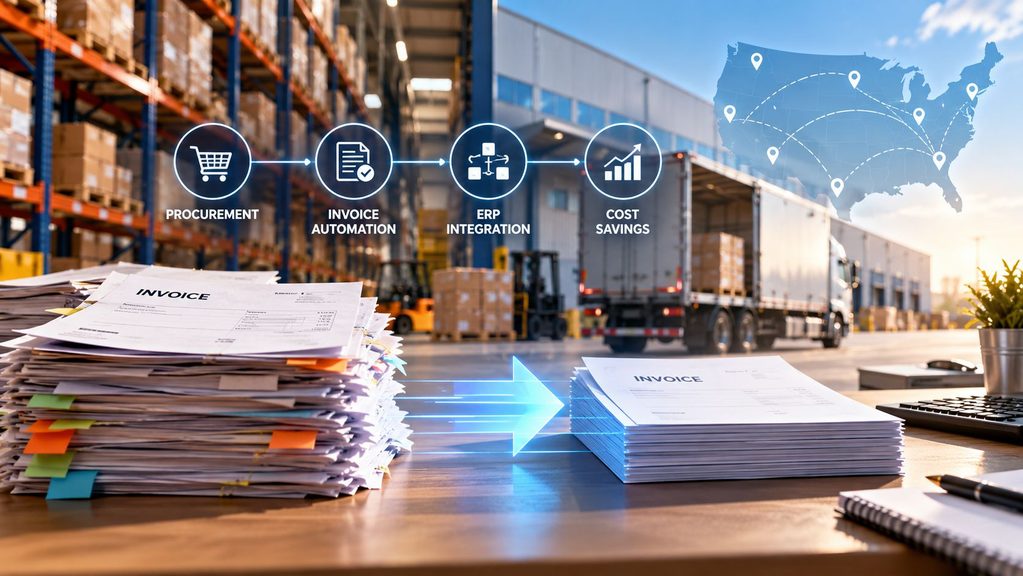
Addressing Fragmented Procurement Across 36 Warehouses
Custom Goods Logistics provides warehousing, transportation, fulfillment, and U.S. Customs examination services. Operating across a distributed warehouse network creates significant coordination requirements, particularly when purchasing decisions, supplier invoices, and financial approvals originate from different locations.
Before implementing Vroozi, purchasing and invoice approval procedures varied between facilities. Accounts payable employees also entered invoice information manually into NetSuite, adding administrative work and creating additional steps between purchasing activity and financial processing.
These challenges are common in multi-location operations, where decentralized purchasing can make it difficult to maintain consistent spending controls and obtain a consolidated view of financial commitments.
Custom Goods Logistics addressed the issue by bringing purchasing activity across more than 100 supplier catalogs into the Vroozi platform.
The company established spending thresholds and approval routing for individual users, creating a more standardized process for purchasing and invoice authorization.
Automated invoice data capture now handles much of the information entry previously performed manually, while a direct connection to NetSuite transfers approved invoices into the ERP environment for subsequent payment processing.
The integration reduces the need to enter the same financial information into multiple systems and creates a more consistent connection between procurement activity and accounts payable records.
Measurable Improvements in Invoice Processing and Financial Visibility
The operational impact is reflected in both processing capacity and the resources required to manage the workload.
According to Vroozi, Custom Goods Logistics increased invoice processing from three to four invoices per hour to six to seven, approaching twice its previous throughput.
At the same time, the company reports that four employees can now manage the AP and procurement workload previously handled by eight.
The resulting efficiency improvements are contributing to estimated annual savings in the six-figure range, although the announcement does not provide a detailed financial breakdown or specify how the savings were calculated.
For the finance team, the benefits also extend beyond processing speed.
Centralized purchasing and automated invoice workflows have improved access to financial information, particularly when determining outstanding expenses and preparing accruals.
“We were able to streamline and create efficiencies and realize about half the cost in that department,” said Ziyad Zreik, Director of AR/AP at Custom Goods Logistics. “It’s a game-changer on the reporting side. We’re able to pinpoint to the penny how much needs to be accrued, instead of sifting through emails.”
This improvement in reporting visibility is particularly relevant to organizations managing purchasing and financial obligations across multiple locations.
When invoice information and approval records are distributed across emails, spreadsheets, and separate operational processes, finance teams can spend considerable time gathering and reconciling information before completing routine accounting activities.
Bringing those processes into a connected environment can reduce that administrative burden while providing a more consistent basis for financial reporting.
Extending Automation to Warehouse Equipment and Asset-Related Costs
Following the initial implementation, Custom Goods Logistics is expanding its use of Vroozi to address additional operational requirements.
One area involves automating data capture for equipment lease invoices, including serial-number tracking for forklifts and other warehouse equipment.
The company has also completed a multi-month project with Vroozi to introduce part-number tracking across the platform.
These developments extend the scope of procurement automation beyond conventional invoice processing toward more detailed tracking of equipment-related expenditures and purchasing records.
For warehouse operators, equipment leases, maintenance-related purchases, and replacement parts can represent recurring operational costs that need to be associated with specific assets or activities.
Capturing more detailed information during purchasing and invoice processing can help finance teams improve the consistency of those records and support more granular cost analysis.
However, the announcement does not indicate that Custom Goods Logistics has implemented predictive maintenance or IoT-based asset monitoring. The reported expansion is focused on improving the capture and tracking of equipment and part-related information within procurement workflows.
Zreik also highlighted the role of implementation support in extending the platform’s capabilities.
“Anytime I email them, they’re extremely quick with their responses, and they always jump on a call no matter what,” Zreik said of the Vroozi team. “We wanted to implement part numbers, more guardrails, more safety nets, and more trackability, and they were very helpful throughout.”
Connecting Procurement Automation with ERP Operations
The Custom Goods Logistics implementation demonstrates an important distinction in enterprise automation: improving an individual task is not necessarily the same as improving the process surrounding it.
Automated invoice capture can reduce manual data entry, but its broader operational value depends on how effectively invoice information connects with purchasing approvals, supplier records, accounting processes, and financial reporting.
In this case, Vroozi serves as the procurement and AP automation layer, while NetSuite remains the ERP environment supporting downstream financial processing.
The combination allows purchasing and invoice workflows to be managed more consistently across facilities without requiring finance employees to duplicate approved transaction data manually.
For organizations with distributed operations, this approach can help establish common purchasing controls while preserving the financial processes managed within their ERP systems.
It also highlights why successful automation initiatives often depend as much on process standardization and data integration as on the underlying technology.
From Transaction Efficiency to Operational Intelligence
The reported results at Custom Goods Logistics provide a measurable example of how targeted finance automation can affect operational capacity.
Higher invoice processing throughput, reduced manual entry, and more consistent approval workflows have allowed the company to manage its existing workload with fewer resources dedicated to those activities.
The next phase, involving equipment lease invoices and part-number tracking, suggests a broader effort to improve the information available across procurement and warehouse operations.
For logistics providers managing multiple facilities, these capabilities can become increasingly valuable as organizations seek greater visibility into purchasing commitments, equipment-related costs, and financial performance.
The case also reinforces a practical lesson for ERP transformation: measurable improvements do not always require replacing core business systems.
By standardizing purchasing processes and connecting specialized automation directly to NetSuite, Custom Goods Logistics reports improvements in both productivity and financial visibility while continuing to use its existing ERP environment.
For finance and procurement leaders, the significance lies in the combination of operational efficiency and stronger information flow. Automation becomes more valuable when it not only processes transactions faster but also makes the resulting data more accessible, consistent, and useful for business decisions.

ERP News Editorial Team
The ERPNews Editorial Team covers global developments in ERP (Enterprise Resource Planning), enterprise software, cloud platforms, AI, automation, and digital transformation, providing independent news and editorial analysis for senior business and technology leaders. Our reporting focuses on market signals, strategic shifts, and enterprise impact across the ERP and enterprise technology ecosystem.
For editorial inquiries, please contact:
📩 [email protected]