Due to many angled surfaces, deep cavities, thin wall areas and close tolerances within a complex part, manufacturing such parts will be very challenging. The problem becomes even greater as each individual machine setup introduces additional positional errors that can add up over time. Maintaining consistent dimensions on all components manufactured for aerospace applications, robotics, medical equipment and other types of industrial equipment is vital for successful assembly, reliability, and extended operation. 5-axis CNC machining offers a solution to this problem. It allows for more than three axes to machine parts in less setups resulting in improved accuracy, surface finish and productivity.
Why Complex Precision Parts Require Advanced Machining
Complex precision parts are unlikely to be composed solely of basic shapes. A single complex part can have an array of unique features such as intersecting bores, sculpted profiles, compound angles, deep recesses or pockets and thin wall areas. Each feature must maintain its location relative to other features so it fits properly into an assembly.
Traditional 3-axis machining typically would require many setup changes to access all features of the part. With each new setup there is a slight misalignment. Though individual misalignments appear minor, over time the misalignment accumulates from operation to operation and affects the placement of holes, bearings, seals and mating surfaces.
Thin-walled areas add another layer of complexity as deflection due to cutting force occurs on lightweight structures while machining. The length required for the cutting tool to reach into deeper cavities increases vibration. This reduces machine rigidity and also affects dimensional accuracy, surface quality and tool longevity if machining strategies do not take into account the geometry of the part.
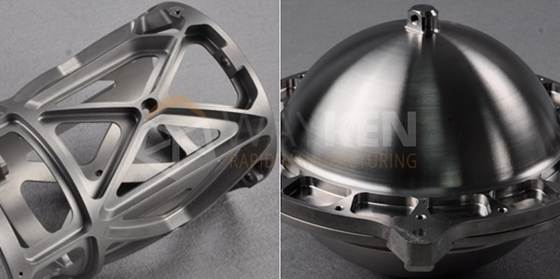
The same importance exists in maintaining geometric tolerance parameters including flatness, perpendicularity, concentricity, and true position. The performance of a part under load is affected by these characteristics, and the smooth movement of assemblies during their service life depends upon them.
How 5-Axis CNC Machining Connects with ERP and Smart Manufacturing
While 5-axis CNC machining takes place on the shop floor, its effectiveness increasingly depends on how well production data flows across the wider manufacturing organization. In a smart manufacturing environment, CNC machines do not operate as isolated assets. They are connected with enterprise resource planning (ERP), manufacturing execution systems (MES), computer-aided manufacturing (CAM), quality management, and production scheduling platforms.
ERP systems provide the operational foundation for this connected environment. Customer orders, bills of materials, routing requirements, material availability, production costs, and delivery targets can be translated into coordinated manufacturing plans. When a complex component requires 5-axis machining, the ERP system helps ensure that the correct material, machine capacity, tooling, workforce, and inspection resources are available at the right time.
Integration with MES and machine-monitoring systems adds real-time visibility to the process. Manufacturers can track machine utilization, cycle times, production status, tool performance, downtime, and quality results. This information allows production teams to compare actual machining performance with planned targets and respond quickly when delays, deviations, or capacity constraints occur.
Digital quality data is particularly important for complex precision parts. Measurements collected through probing systems and inspection equipment can be associated with individual work orders, batches, or serial numbers. This creates end-to-end traceability and helps manufacturers document that dimensional and geometric requirements have been met. The same data can also support continuous improvement by identifying recurring variations and opportunities to optimize machining parameters.
Connecting 5-axis CNC machining with ERP and smart manufacturing platforms therefore creates value beyond the machining operation itself. It links engineering decisions with production planning, quality control, inventory management, costing, and delivery performance. For manufacturers producing complex, low-volume, or highly customized parts, this connected approach can improve resource utilization, strengthen traceability, reduce production risk, and provide more reliable delivery estimates.
How 5-Axis CNC Machining Improves Manufacturing Accuracy
5 axis CNC machining addresses some of these manufacturing issues through the ability to position the cutting tool in a multitude of ways toward the workpiece in one fixturing setup. Unlike traditional methods where the part is moved between numerous sets, the machine will adjust its tool angle as necessary to create difficult-to-reach features on a part with respect to other datum points while maintaining a constant datum point.
Reduced number of fixturing setups results in less tolerance “stack up” and allows for better positioning relationships among drilled holes, machined surfaces, and locating surfaces. The precision and consistency provided is specifically beneficial to components that have intersecting features or multiple compound angles which may require additional machining operations.
Continuous adjustment of tool orientation provides improvement in cutting conditions. Shorter tool overhang improves overall tool rigidity, decreases vibrations, and enhances surface finishes; especially when machining large cavities or complex shapes. Additionally, improved tool access enhances chip removal in tight spaces resulting in less heat generated and thus less distortion during the entire machining process.
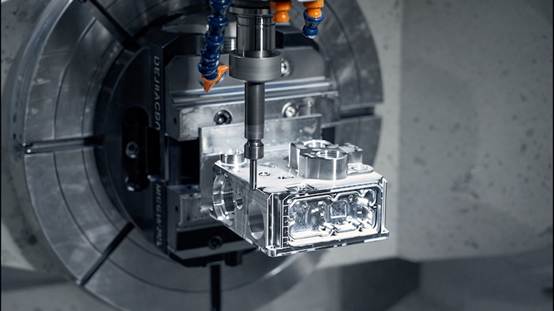
Another benefit is reduced fixture complexity. Components requiring separate fixtures for different machining steps are typically produced in one fixture configuration providing quicker set-up times and repeatable accuracy for both prototype and small batch run productions.
How WayKen Handles 5-Axis Machining to Custom Parts
Complexity is inherent in many custom precision machined components. These parts typically have compound angles, deep cavities, thin-walled sections and free-form surfaces which make them challenging to machine using traditional CNC techniques. As a precision CNC machining service provider, WayKen has developed methods for overcoming these complexities through use of multi-axis simultaneous (5-Axis) machining technology; experience-based process planning; and high speed machining capability.
The in-house engineers develop and apply optimal machining strategy, tooling and fixture designs along with optimal cutting sequence(s) based on part geometry prior to beginning production. Components are then manufactured using Jingdiao JDGR300 and JDGR400T 5-axis machining centers. With these machining centers, all required surfaces can be machined in a single setup. High speed spindles, precision work holding, and Renishaw probing systems allow WayKen to maintain accuracy throughout the entire machining cycle while minimizing cumulative positioning error due to repeated re-orientation during machining.
Using this method, they are able to manufacture custom precision machined parts having complex geometric shapes; smooth surface finish requirements; and close tolerance specifications in support of both prototype development and limited volume production.
Conclusion
Complex parts require precise machining processes to produce high-quality surfaces, geometric relationships, and accurate dimensions. 5-axis CNC machining allows for less variability in setups; better machine tool stability; and is able to create an increasing amount of complicated detail with higher consistencies compared to traditional multi-setups. WayKen’s ability to provide an engineering review, manufacture the part using 5-axis machining, and monitor the process as it relates to product development within one continuous workflow provides support for manufacturers developing custom precision parts from prototype to low-volume production.