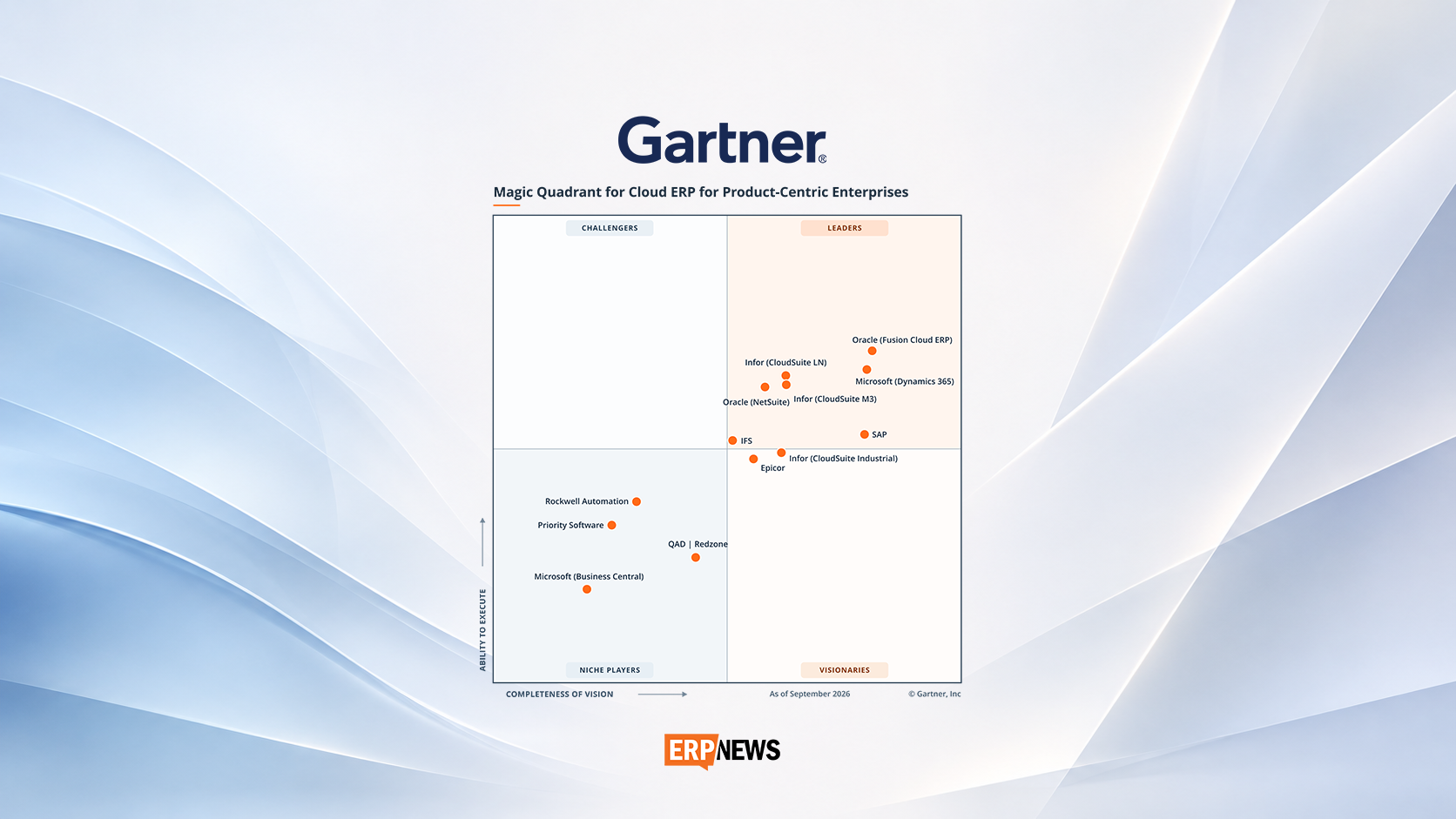
Gartner placed seven of 13 offerings in the Leaders quadrant of its 2026 Magic Quadrant for Cloud ERP for Product-Centric Enterprises, published November 2. Oracle Fusion Cloud ERP was the highest and farthest right on the chart, leading on both Ability to Execute and Completeness of Vision. Oracle NetSuite also landed in Leaders. Infor had two Leaders, CloudSuite LN and CloudSuite M3, while its SyteLine-based CloudSuite Industrial landed in Visionaries alongside Epicor Kinetic.
Microsoft Dynamics 365 Business Central and QAD | Redzone joined this year’s evaluation as Niche Players. Gartner dropped SAP Business ByDesign because SAP is no longer actively marketing it. SAP Cloud ERP, a separate offering, remained in Leaders. The Challengers quadrant was empty.
What Gartner evaluated
This report covers cloud ERP for businesses that make, distribute, deliver, or service physical goods. Gartner’s criteria cover supply and demand planning, direct materials procurement, at least one manufacturing model, fulfillment, core finance, and sustainability capabilities. The baseline also includes embedded conversational AI and foundational support for agents. More advanced capabilities, such as autonomous workflows that coordinate several business steps, are optional.
Gartner evaluates distinct ERP core code lines separately. To qualify, a product had to meet criteria that included at least 200 qualifying organizations live on the cloud service and at least $35 million in booked cloud subscription and support revenue for the applicable 12-month period. Gartner also gave more weight to market responsiveness and track record this year, reflecting the importance it places on delivery and customer adoption.
Infor’s three CloudSuites serve different manufacturing models
Infor CloudSuite LN
Gartner placed LN in Leaders. It serves complex discrete manufacturers, including aerospace and defense, automotive, and engineer-to-order businesses. Gartner highlighted Infor’s industry-specific process models and the use of Velocity Suite to identify bottlenecks across engineering, project management, production, and supply chain operations. Infor OS provides the integration and workflow tools to act on those findings across applications.
The analysts advised buyers to weigh the cost and scope of Velocity Suite against the specific processes they want to improve. For a multinational rollout, the relevant measure of delivery capacity is the availability of people with LN implementation and localization experience in each country.
Infor CloudSuite M3
M3 also landed in Leaders. Its strengths are especially relevant to process manufacturers and distributors. Gartner highlighted recipe and formula management, attribute-based planning, traceability, and support for complex distribution. Those capabilities matter in sectors such as food and beverage, chemicals, and apparel, where the attributes or history of a batch can affect how it is planned, used, or shipped.
Gartner flagged M3-specific localization and implementation expertise as areas to verify by country. It also raised a portfolio question for groups that run process and discrete manufacturing across different divisions. Buyers need to establish which operations M3 can cover and where another ERP foundation would enter the design. The business case for Velocity Suite also depends on which process improvements the buyer plans to pursue.
Infor CloudSuite Industrial
Gartner placed CloudSuite Industrial in Visionaries. Built on SyteLine, it targets midsize industrial manufacturers, including automotive suppliers and aerospace component makers. The analysts credited its configurable production workflows and its use of shared Infor OS and Velocity Suite capabilities to bring process analysis and automation into manufacturing work.
The distinction for buyers is what SyteLine handles in the ERP core and what the broader CloudSuite or a partner supplies. Gartner flagged reliance on partners for some localizations and regional support. It also pointed to a separate SyteLine roadmap, which buyers should examine alongside Infor’s plans for the shared platform.
How the other five Leaders differ
Oracle Fusion Cloud ERP
Fusion serves upper-midsize and large enterprises, with procurement, warehouse management, human capital management, and enterprise performance management available on a shared architectural foundation. Gartner credited Oracle’s semantic data layer for giving AI tools more business context and highlighted the ability to choose models in Oracle AI Agent Studio. These capabilities support Oracle’s strategy of embedding agents in role-specific applications.
Gartner identified two areas where evidence matters. First, buyers with unusually complex production should seek references that run a comparable manufacturing model. Gartner sees stronger adoption in enterprise-wide transformation programs than in particularly complex manufacturing environments. Second, buyers should check production adoption for the agent workflows they plan to use and model the costs of allowances and metered consumption as usage grows.
Microsoft Dynamics 365 Finance and Supply Chain Management
Gartner credited Microsoft’s investment in AI across procurement, manufacturing, supply chain, and finance. It also highlighted the integration of Dynamics 365 with Dataverse, Fabric, Power Platform, and Microsoft 365, as well as a global partner network that can provide local and industry-specific capabilities.
That breadth gives buyers choices about how to build the solution. Gartner’s cautions concern ownership of integrations and extensions, comparable customer references for large transformations, and the timing of AI releases. The report identified some specialized source-to-pay agents as being in production-ready preview during the evaluation. The availability and support terms for those agents are therefore part of the implementation schedule.
SAP Cloud ERP
Gartner evaluated SAP Cloud ERP, formerly SAP S/4HANA Cloud Public Edition. It highlighted SAP Signavio for finding and modeling process changes before a rollout and Green Ledger for linking carbon and energy data to business transactions. The report also examined SAP’s plans to use Joule, SAP Business Data Cloud, and the SAP Knowledge Graph to coordinate agents across finance, supply chain, and manufacturing.
Gartner advised buyers to check public-cloud references with comparable plants, country requirements, and operational complexity. It also called attention to how the core subscription, optional platform services, and AI consumption fit together commercially. The broader Autonomous Enterprise strategy spans capabilities at different stages of availability and adoption, so buyers need to establish which parts are in scope for their deployment.
IFS Cloud
Gartner highlighted IFS Cloud’s ability to combine mixed-mode and engineer-to-order manufacturing with project management, enterprise asset management, and field service. That combination is relevant when the company that builds a piece of equipment also installs, maintains, or repairs it. The analysts credited IFS’s configurable platform and its investment in applying industrial AI to work such as maintenance planning and replenishment.
The report distinguishes the maturity of the core ERP, asset, and service capabilities from newer AI and supply chain investments. Gartner also cited a smaller pool of experienced implementation resources than some larger providers and variability in support when several companies share responsibility after go-live. A multinational buyer should check who can deliver each country rollout and who will own a production issue that crosses ERP, asset management, and field service.
Oracle NetSuite
NetSuite’s Leader placement covers a different part of the market from Fusion, primarily small through upper-midsize companies. Gartner credited its mature SaaS delivery, established implementation practices, and app ecosystem. It also highlighted NetSuite Next and the AI Connector Service, which Gartner says NetSuite provides at no additional charge for the connector itself.
For manufacturers, the key question is how far native production functionality goes before a SuiteApp or other partner product is needed. Gartner also flagged the limited visibility of NetSuite’s public roadmap and the potential for costs to rise as a business adds users, modules, and subsidiaries. A useful quote would price the expected multi-site operation as well as the first deployment.
Epicor Kinetic and the four Niche Players
Epicor Kinetic
Gartner placed Epicor Kinetic in Visionaries. It highlighted Epicor’s manufacturing data models and workflows as the foundation for Prism AI, which customers and partners can use to build agents with manufacturing context. The analysts also noted Epicor’s work on planning and scheduling and its Ascend program, which applies AI to migration and implementation work.
Some of the more advanced capabilities were still early in adoption. Gartner described Epicor’s Model Context Protocol server as being in controlled release and Agent2Agent interoperability as still under evaluation. Kinetic’s manufacturing focus also shapes the rest of the selection. Businesses seeking a common platform across several industries, or rolling out beyond Epicor’s core North American market, should check functional fit, local support, and partner capacity.
Microsoft Dynamics 365 Business Central
Business Central entered the report as a Niche Player. Gartner highlighted its accessibility for smaller manufacturers and distributors, integration with familiar Microsoft tools, and early adoption of Copilot capabilities for work such as order processing and finance. Its scope and reliance on partner applications become more consequential as manufacturing requirements grow more specialized.
For a buyer, the practical question is who supplies and maintains each required capability across Business Central, partner extensions, and the wider Microsoft platform. Gartner says Microsoft declined to provide supplemental information or review the draft, so the analysts used other sources for this assessment.
Priority Software
Gartner placed Priority ERP in Niche Players. The suite brings together manufacturing, warehousing, supply chain, and finance for small and midsize businesses. Gartner singled out low-code tools for building mobile apps and supplier or customer portals, as well as the aiERP Companion’s ability to put AI assistance within ERP workflows.
Priority’s customer and delivery base is concentrated in EMEA, with partner-led expansion in North America. Gartner advised buyers to verify local implementation and support capacity, clarify who maintains partner-built functionality, and seek production references for the newer AI tools.
QAD | Redzone
Gartner added QAD | Redzone as a Niche Player. It highlighted QAD Adaptive ERP’s manufacturing and supply chain expertise, its use of transaction data to identify exceptions and guide users through corrective action, and its support for adding capabilities in phases. That approach can suit manufacturers that need to modernize around an existing ERP environment while keeping operations running.
Gartner pointed to limited implementation capacity relative to larger providers and early customer adoption of some newer AI and process intelligence features. Buyers planning a transformation across manufacturing and corporate functions should also examine how much of QAD’s roadmap extends beyond the plant and supply chain.
Rockwell Automation Plex
Rockwell Automation landed in Niche Players with Plex. Gartner highlighted the combination of ERP, manufacturing execution, and quality management on a single cloud platform. Linking production, inventory, quality, and traceability data gives Plex a clear use case for manufacturers that want to see what is happening on the shop floor and act on it within the same system.
Plex’s installed base remains concentrated in North America, according to Gartner. Buyers should check implementation and localization capacity elsewhere and assess the roadmap for finance, customer operations, and workflows spanning several business functions. Rockwell’s investments in Plex are concentrated on manufacturing execution, quality, and factory operations.
Products Gartner mentioned outside the quadrant
Gartner also identified 10 honorable mentions outside the formal scoring. They include Acumatica Cloud ERP for midsize businesses seeking a partner-led implementation, BOT Agentic ERP for manufacturing and distribution, Rootstock Cloud ERP for Salesforce-centered manufacturers and distributors, and Syspro ERP for midsize manufacturers and distributors. Sage X3 was cited for its relevance to midsize manufacturers, distributors, and process industries.
The report separately mentioned Epicor Prophet 21 and Infor CloudSuite Distribution with SX.e for wholesale distribution, particularly in North America. It also identified Kingdee’s AI Portfolio and Yonyou’s YonBIP for China and selected international markets, and TOTVS for Latin America, particularly Brazil.
Gartner’s companion Critical Capabilities research looks more closely at discrete, process, and project- or asset-intensive manufacturing, among other use cases. A buyer can put those distinctions to work in a scripted demo. Start with a material shortage or a failed quality check, then follow the resulting production change through inventory, customer commitments, and the general ledger. The handoffs reveal which parts the ERP can handle, where another system comes in, and who owns the exception.
Sources
- Gartner, Magic Quadrant for Cloud ERP for Product-Centric Enterprises (Tomas Kienast, Johan Jartelius, Dennis Gaughan, Greg Leiter, and Dixie John, November 2, 2026)
- Gartner reprint of the product-centric report
- Gartner, Critical Capabilities for Cloud ERP for Product-Centric Enterprises

ERP News Editorial Team
The ERPNews Editorial Team covers global developments in ERP (Enterprise Resource Planning), enterprise software, cloud platforms, AI, automation, and digital transformation, providing independent news and editorial analysis for senior business and technology leaders. Our reporting focuses on market signals, strategic shifts, and enterprise impact across the ERP and enterprise technology ecosystem.
For editorial inquiries, please contact:
📩 [email protected]