Talkdesk has introduced Voyager, a customer journey orchestration product designed to keep processes such as appointment scheduling, repeat purchasing, and loan applications moving across multiple interactions. Built on its Customer Experience Automation (CXA) platform, the product coordinates AI agents, employees, and connected business systems around a defined outcome, including work that requires waiting for a response or a later event.
The company announced Voyager on November 12. Its release notes list November 16 as the preview release date, with access limited to selected customers. Supported channels, integrations, event sources, and capabilities depend on the customer’s release, region, and account configuration.
Voyager addresses the follow-up work that can stretch well beyond an initial customer conversation. A patient may need an appointment that is not yet available. A borrower may leave an application incomplete. A retailer may have an opportunity to contact a customer when a previously purchased product is due for replenishment. Talkdesk says Voyager can maintain the relevant context and coordinate subsequent actions over days, months, or years.
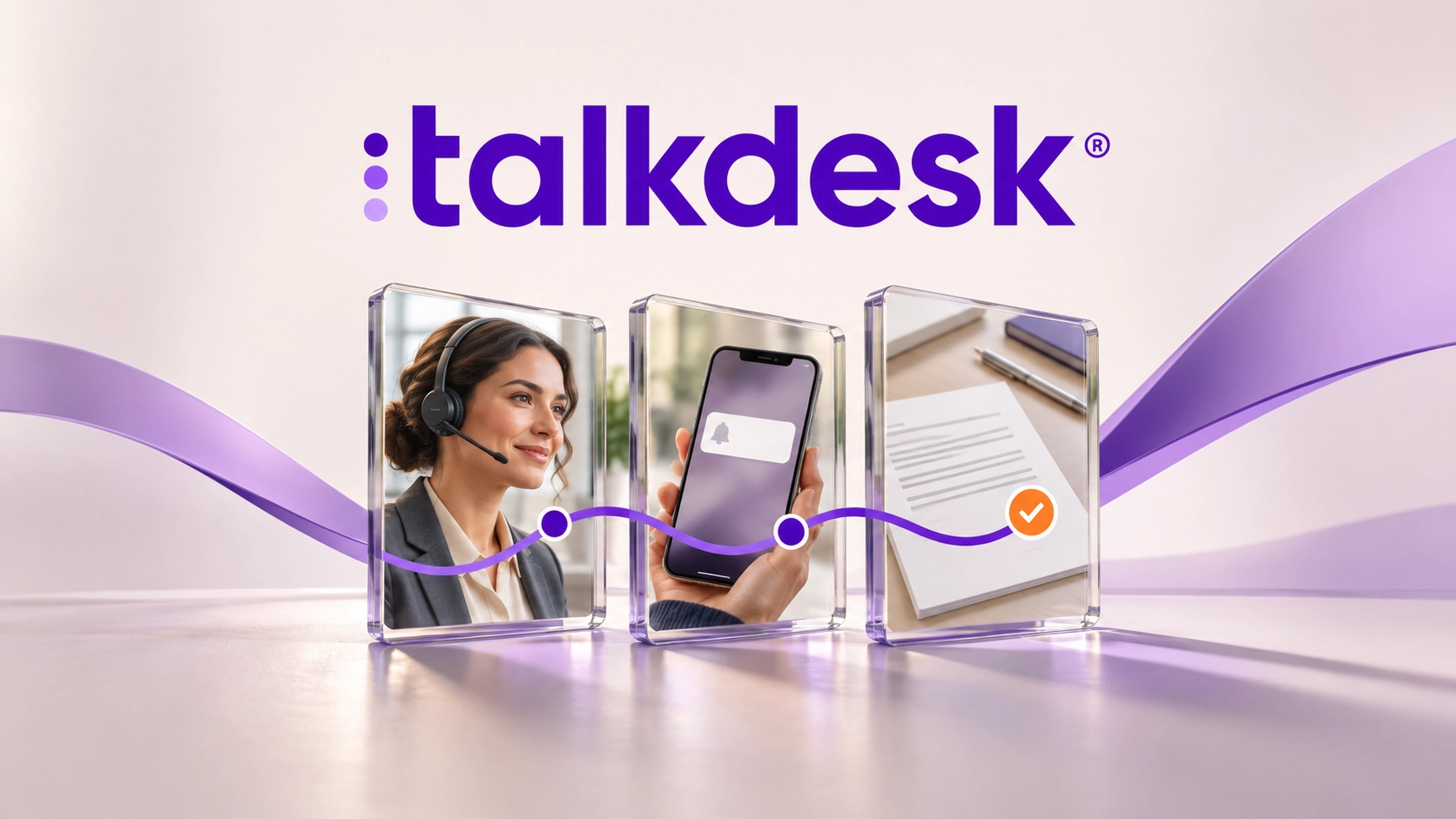
How a journey moves from signal to action
According to Talkdesk’s building and publishing documentation, teams construct journeys on a visual canvas, connecting triggers, communication steps, business rules, and AI functions. A journey can begin manually, on a schedule, or through a supported Talkdesk inbound workflow event.
Two AI functions determine how work proceeds. Outcome Assessment analyzes a customer reply or completed interaction and selects the next route. Agentic Loop gives a step an operator-defined goal and guardrails, allowing it to carry out a bounded sequence of actions before returning a result to the wider journey.
The documented workflow steps include waiting for a supported external event, invoking a Talkdesk Studio Flow, running a sub-journey, and writing supported outcomes back to a connected customer system. Teams can test configurations against simulated participants before contacting customers. Running journeys remain tied to the versions they started with, so subsequent edits do not silently alter work already underway.
Customer information enters through audience records, triggering events, data sources, and outputs from earlier steps. Supported sources include CSV or Excel files, APIs, and Talkdesk DataCloud segments. Information mapped into journey variables can then support later messages, routing decisions, and connected actions.
There are specific boundaries to that behavior. Dynamic audience membership is evaluated when a run begins; later changes to a person’s information do not change their enrollment in an existing run. The overview also states that an inbound trigger starts a new journey rather than waking or redirecting one already running. Voyager does not take over a live call, chat, or AI-agent conversation.
Industry blueprints target specific operational tasks
Talkdesk’s announcement describes prebuilt blueprints combining signals, agents, workflows, business rules, and integrations. Businesses can use them as supplied, adapt them, or build their own journeys.
In healthcare, the examples cover preventive screenings and post-discharge follow-up. Tasks include collecting intake forms and clinical consents, checking appointment availability, arranging reminders, and involving nurses when clinical follow-up is required. Reducing avoidable 30-day readmissions is among the intended outcomes. The announcement does not provide measured Voyager customer results establishing that reduction.
Retail examples begin with buying intent, an abandoned cart, or an approaching replenishment window. The proposed journeys coordinate recommendations, specialist assistance, and fulfillment. Financial services blueprints address unfinished loan applications, savings interest, and approaching certificate-of-deposit maturities, with authorized specialists involved in documents, guidance, and approvals.
These processes extend the orchestration issue covered in ERP News’ earlier reporting on Talkdesk’s agentic automation research: completing customer work can require coordination across departments and applications. Voyager adds a product specifically organized around those continuing journeys. The announcement does not identify a particular ERP connector or establish universal compatibility with enterprise applications.
Persistent context comes with access and retention conditions
Talkdesk describes Voyager as retaining customer and journey context across channels. Its product FAQ qualifies how that information may carry into future journeys: access to business history and selected long-term memory remains subject to authorization and retention policies.
The company also describes permissions, approvals, enterprise rules, and human oversight through CXA. Those controls are intended to let organizations monitor progress and intervene when exceptions arise. Businesses evaluating a deployment will need to confirm the available integrations and supported actions for their account with Talkdesk, as the preview documentation specifies.
Sources

ERP News Editorial Team
We cover ERP and enterprise technology for the people who select, implement, and run these systems.
Pitch a guest article or work with our editorial team on a news story, customer case study, or executive interview.
Editorial Calendar · Pitch a Guest Article · Commission a Story
Advertising Options · ERP News Magazine · ERPNews.com
Editorial Inquiries · [email protected]
Copyright & Usage · Our original editorial content is produced by the ERP News Editorial Team, with expertise in ERP and enterprise technology.
© ERP News. All rights reserved. Except as permitted by law, reproduction, republication, and redistribution require prior written permission or a licence from ERP News, along with clear attribution to ERP News as the source.
ERP News Content Licensing · License full-text ERP News articles for your internal research tools, delivered through a private JSON feed. [email protected]