
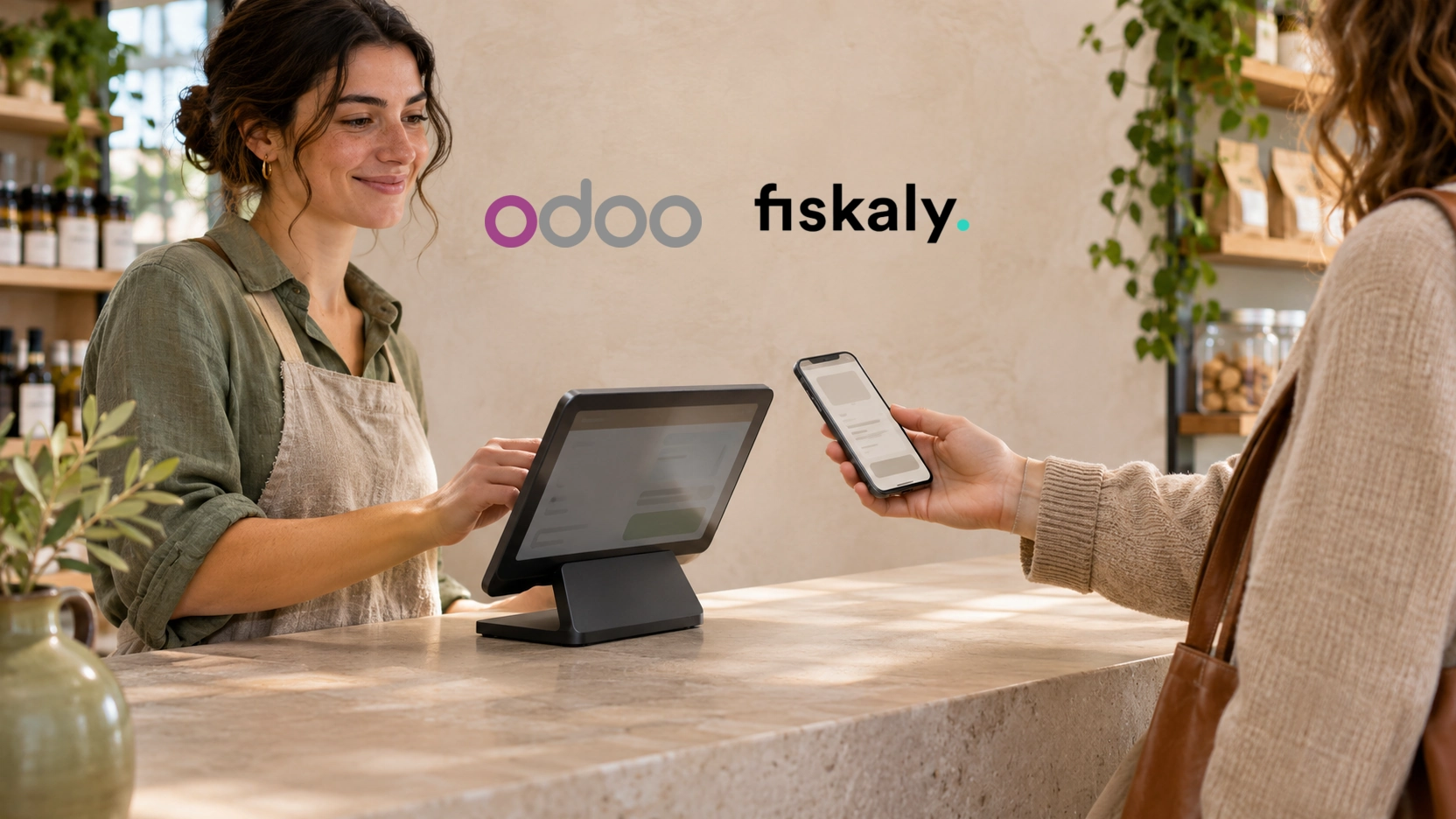
Odoo Italia has integrated fiskaly into its point-of-sale software so Italian merchants can send retail sales data to the Agenzia delle Entrate, the country’s revenue agency, through the cloud. Odoo announced the integration on November 9 and said it would offer it to customers at no additional charge. The company says merchants using the integration can report sales in real time without a dedicated fiscal printer or a telematic cash register, known in Italy as a registratore telematico (RT).
The launch comes as Italy develops a formal approval process for software that records and transmits retail sales data. fiskaly says its software for that framework is in a certification pilot and is expected to reach the market in the first part of 2027. The companies identify SIGN IT as the service behind the Odoo integration. Their announcements leave the specific variant used at launch unspecified.
What changes at the checkout
Italy’s retail reporting system involves two related records. The documento commerciale documents an individual sale and includes information such as the merchant’s VAT number, what the customer bought, the applicable tax rate, and how the customer paid. Corrispettivi refers to the sales amounts that merchants must record and report electronically. A telematic register stores transaction data locally and prepares a file for the revenue agency at daily close. The agency’s own online procedure records the details of each sale as the merchant issues the document.
Under the Odoo integration, the cashier records the sale in Odoo POS and fiskaly handles the fiscal transmission. For a retailer replacing a dedicated fiscal device, that can remove the cost of buying, maintaining, and periodically inspecting it. Odoo’s pricing announcement covers the integration itself. Its announcement leaves supported Odoo versions, hosting options, and the steps for switching an existing store from an RT unspecified.
Italy also requires merchants within scope to link their electronic payment devices to the system they use to record and report sales. The revenue agency provides a way to register that link through its portal, including for merchants who use its online document procedure. Odoo’s announcement leaves open how a store’s existing payment-terminal registrations are handled when it switches to the new integration.
Italy is testing a new approval framework
The hardware route remains widespread. In a November 4 response to Italy’s parliamentary Finance Committee, Economy and Finance Undersecretary Lucia Albano said roughly 95% of merchants used telematic registers and the rest used the revenue agency’s online procedure. She said the agency had never authorized third-party tools that automate the web procedure through a separate interface and was testing ways to detect and block them. The response addressed that category of software generally.
fiskaly describes SIGN IT lite as a service that connects to the agency’s existing portal and says it remains operational. The company says it is piloting a separate version under the approval framework set out in the agency’s March 2025 technical ruling. Under that framework, a registered software component at the point of issue records individual transactions, and a processing component transmits daily sales totals to the agency. fiskaly’s November 6 update places the planned commercial release of that version in early 2027, subject to the approval process.
What happens when a receipt submission fails
A November 2 incident shows how a portal outage can reach the checkout. fiskaly reported that receipt submissions from SIGN IT timed out or returned errors when the revenue agency’s portal became unavailable. Some requests that appeared to fail could still have reached the agency. fiskaly told users to check whether those documents had been registered before resubmitting them, to avoid duplicates. The incident preceded the Odoo announcement and illustrates why a failed submission and an unconfirmed submission may require different steps.
For the portal-based service, fiskaly’s support guidance describes a fallback involving a temporary paper document and a subsequent electronic invoice when a retry fails. Odoo’s launch materials leave several store-level details open, including what the cashier sees after a failed submission, whether the POS retries automatically, and how staff verify which transactions reached the agency before closing the day.
Italy is the third market in the partnership. Odoo already uses fiskaly’s SIGN DE in Germany and SIGN AT in Austria, where the reporting requirements differ. Silvio Agresti, fiskaly’s country manager for Italy, said fiskaly would handle regulatory updates. Luciano Tramontano, head of services at Odoo Italia, said the integration’s design would help Odoo respond faster to merchant feedback about the Italian checkout workflow.
Sources
- Odoo Italia’s November 9 announcement
- fiskaly’s announcement on the Odoo POS integration
- Guardia di Finanza guidance on commercial documents and daily sales reporting
- Italian Revenue Agency guidance on linking payment devices to sales reporting systems
- Italian Chamber of Deputies, November 4 Finance Committee response
- Italian Revenue Agency’s March 2025 ruling on software-based sales reporting
- fiskaly’s November 6 update on its Italian certification pilot
- fiskaly’s incident report on the November 2 submission failures
- fiskaly’s support guidance for connection failures

ERP News Editorial Team
The ERPNews Editorial Team covers global developments in ERP (Enterprise Resource Planning), enterprise software, cloud platforms, AI, automation, and digital transformation, providing independent news and editorial analysis for senior business and technology leaders. Our reporting focuses on market signals, strategic shifts, and enterprise impact across the ERP and enterprise technology ecosystem.
For editorial inquiries, please contact:
📩 [email protected]